Brand partnerships aren't reserved for Nike and Apple. Some of the most effective growth moves for small brands come from teaming up with another small brand that reaches the same audience through a different product. No media budget required. No co-branded Super Bowl spot.
The problem isn't the concept. It's the execution. Most founders know partnerships could help but get stuck on the basics: who to partner with, what to propose, and how to make it worthwhile for both sides. This guide covers all of it, specifically for brands operating on limited marketing budgets who want to grow through partnerships rather than just look cool.
Brand Partnerships at the $0–$5K Level
Forget celebrity collaborations and limited-edition product drops. Those are for brands with six-figure marketing budgets. Here are the formats that work when you have a small audience and little to no cash to spend.
Content swaps. You feature their brand in your content, they feature yours. An Instagram post, a newsletter mention, a blog shoutout. Zero cost. Shared audiences. This is the simplest partnership format and the easiest one to get a yes on, because the commitment is low for both sides.
Co-hosted events. Split the work and the audience. A joint Instagram Live Q&A. A co-hosted workshop or webinar. A collaborative Twitter/X Space. Each brand promotes to their list, so you both benefit from double the reach without double the effort.
Bundle offers. Combine your product with a complementary brand's product and sell or promote it as a package. A coffee brand and a ceramics studio running a "morning ritual" bundle. A fitness apparel brand and a supplement company offering a starter pack. The bundle gives both brands exposure to each other's customer base.
Shared email sends. Each brand sends a genuine recommendation of the other to their email list. This works because it carries trust. A recommendation from a brand you already follow lands differently than an ad in your feed. Keep it personal and authentic, not a templated "check out our partner" blast.
Co-created content. A joint blog post. A shared research report. A collaborative social media series where you alternate posts on a theme. This works especially well when both brands have overlapping expertise and can produce something together that neither would create alone.
Each of these costs almost nothing. The currency isn't money. It's audience attention and creative effort.
How to Find Brands Worth Partnering With
This is where most founders stall. They think of brands they personally admire but don't know how to assess whether a partnership would actually work. Admiration isn't enough. You need audience overlap.
Start With Your Audience's Other Interests
What else do your customers follow, buy from, or talk about? Check your Instagram followers' bios and the accounts they tag. Look at the subreddits and communities your audience participates in. What brands keep showing up?
If you sell fitness apparel, your audience probably also follows supplement brands, meal prep services, and workout apps. If you sell artisan candles, your audience might overlap with small-batch skincare brands, independent bookshops, or home decor studios. Those adjacent brands are your potential partners.
Look at Your Competitors' Partners
Who are your competitors collaborating with? Check their tagged posts, co-branded content, and recent campaigns. If a competitor ran a successful content swap with a particular brand, a similar partnership format could work for you with a different brand in the same category.
Tools like Draper can scan your competitors' content and show you which other brands and creators they're collaborating with, saving you the manual research. But even a 20-minute scroll through a competitor's tagged photos and recent posts will surface useful leads.
Use the "Adjacent, Not Competing" Rule
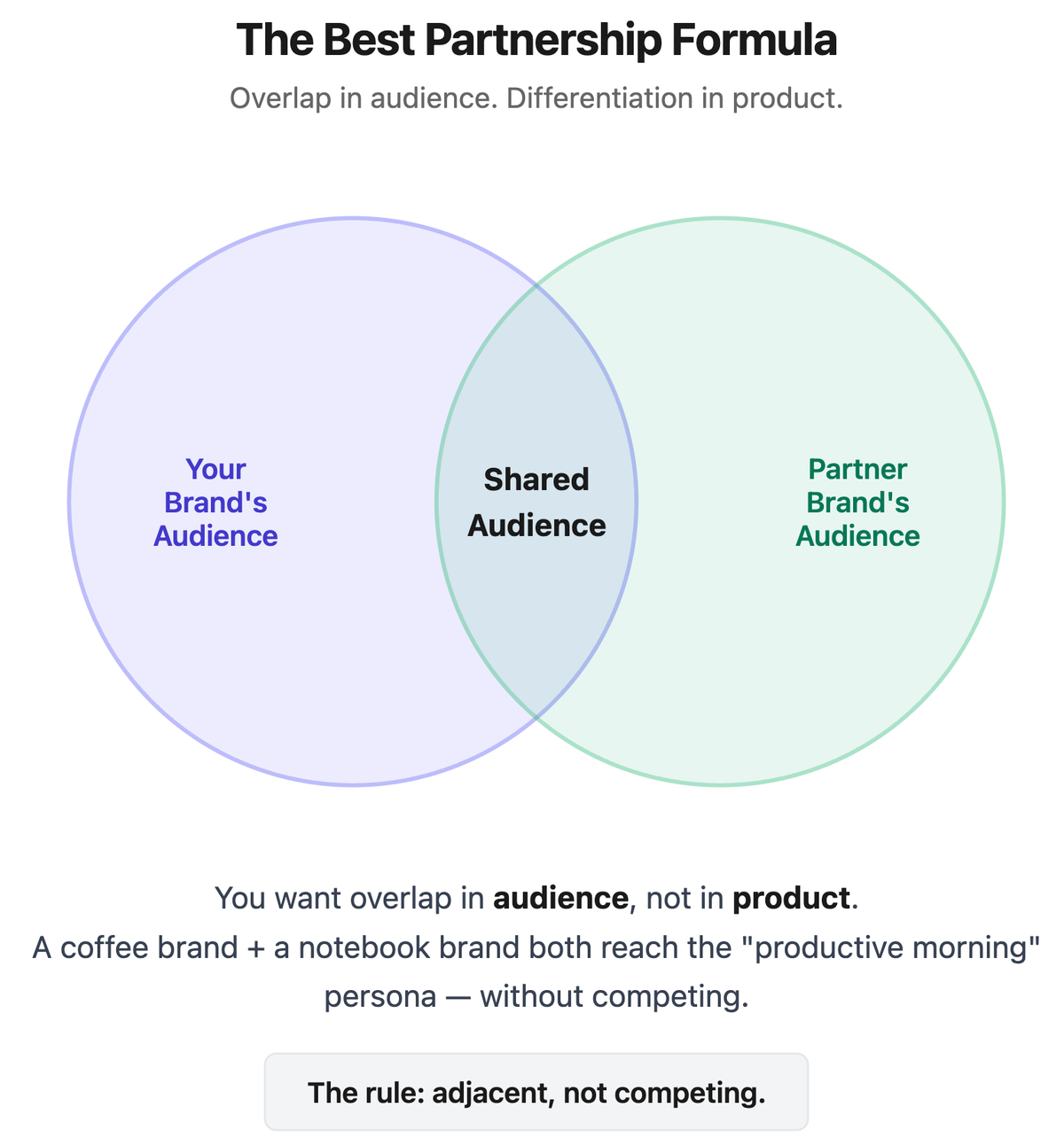
The best partnerships happen between brands that serve the same audience through different products or services. You want overlap in audience, not overlap in offering.
A coffee brand and a notebook brand both target the "productive morning" persona without competing. A yoga studio and a natural skincare brand share an audience interested in wellness without selling the same thing. A B2B SaaS tool and a business podcast reach the same founders through different channels.
This is the single most important filter. If you remember one thing from this article, make it this: adjacent, not competing. Audience overlap plus product differentiation is the formula.
How to Pitch a Partnership When You're the Smaller Brand
Most partnership pitches fail because they're vague. "Hey, would love to collaborate sometime!" doesn't give anyone a reason to say yes. Be specific about what you're proposing and what's in it for them.
A good pitch includes four things:
- What you're proposing. Be concrete. "I'd like to do a content swap where we each feature the other in one Instagram post and one email newsletter edition" is clear and easy to evaluate.
- Why it makes sense for them. What do you bring? Your audience size, your engagement rate, the demographic overlap. Don't inflate these numbers. Honesty here builds the trust the whole partnership depends on.
- What the commitment level is. Make it easy to say yes by keeping the first collaboration small. One post each. One email each. One joint event. You can always scale up after proving the value.
- A clear next step. "Would you be up for a 15-minute call this week to explore?" or "Want me to draft up a quick plan?" Don't leave the conversation open-ended.
Send this via DM or email. Keep it under 200 words. Skip the long PDF deck. Nobody at a small brand has time to read a partnership proposal document. If the idea is good and the pitch is clear, a DM is enough.
What kills pitches: being vague about what you want, asking for something without offering anything in return, or sending a generic message that could have gone to any brand. Personalize it. Reference something specific about their brand or content that made you reach out.
Executing a Partnership That's Worth Repeating
Getting the yes is step one. Making it work so both sides want to do it again is where the real value lives.
Set clear goals before you start. Are you going for awareness, email signups, direct sales, or content assets? Both partners should agree on what success looks like. Otherwise you'll finish the collaboration and have no idea whether it worked.
Agree on deliverables and timelines upfront. Who posts what, when, and where? Who writes the copy? Who approves the creative? Nail this down before anyone creates anything. Small misunderstandings here can sour an otherwise good partnership.
Track results. Use UTM links, unique discount codes, or dedicated landing pages to measure what the partnership drove. "It felt like it went well" isn't a metric. If you can show your partner that the collaboration sent 200 people to their site or added 50 subscribers to their list, they'll want to do it again.
Follow up with results and a suggestion for round two. The best brand partnerships aren't one-offs. Share what you learned, what worked, and propose the next collaboration. Maybe the content swap went well and now you try a bundle offer. Partnerships that grow over time compound in value because both audiences become increasingly familiar with the other brand.
Start With One
You don't need a massive audience to be a good partner. You need a specific, engaged audience and a clear idea of what you can offer. Start with one partnership. Keep the scope small. Prove the value. Let it grow from there.
The brands that grow fastest on small budgets are the ones who figure out that two small audiences combined are more powerful than one small audience working alone.