Micro influencers are the best customer acquisition channel most small brands ignore. Not because founders don't know about them, but because finding the right ones feels impossible without paying for an expensive discovery platform.
It doesn't have to be. The best micro influencer partnerships often start with a manual search, a DM, and a $200 test campaign. This guide covers how to find micro influencers without paying for a platform, how to evaluate whether they're worth your budget, and when AI tools can speed up the process.
The short version: You don't need a platform to find great micro influencers. Start with hashtag searches, your own followers, and competitor tagging. Vet for authentic engagement, not follower count. Scroll to "How to Vet a Micro Influencer" for the checklist.
What Actually Makes a Micro Influencer Worth Your Money
Forget the 10K–100K follower definition. Follower count is the least useful metric for evaluating a micro influencer. What matters is whether they can move their audience to care about your product.
Their audience overlaps with yours. Not just similar demographics. Similar interests and buying behavior. A fitness creator with 15,000 followers who posts about budget home workouts is a different audience than a fitness creator with 15,000 followers who posts about luxury gym memberships. Same follower count. Completely different fit.
Their content feels authentic. Scroll their feed. Does it look like a person sharing things they care about, or an ad factory that posts a different sponsored product every third day? Audiences can tell the difference, and so should you.
Their engagement comes from real conversations. Look at the comments. Are people asking genuine questions, sharing their own experiences, tagging friends? Or is it rows of fire emojis and "love this!" from other influencer accounts? Engagement pods, where creators agree to like and comment on each other's posts, inflate engagement rates artificially. The comments tell you more than the numbers.
They've posted about topics adjacent to yours before. A creator who already talks about skincare ingredients is a natural fit for a skincare brand. A creator who's never mentioned anything related to your category will feel like a paid placement, because that's exactly what it is.
How to Find Micro Influencers Without Paying for a Platform
Hashtag and Keyword Searching
On Instagram: Search niche hashtags in your category. Not the broad ones with millions of posts, but the specific ones. If you sell sustainable workwear, search #sustainableworkwear or #ethicalfashionfinds, not just #fashion. Sort by recent. Look for accounts with 2,000–50,000 followers that are getting real comments on their posts.
On TikTok: Search your category keywords and look at creators whose videos consistently get 10,000+ views without massive followings. TikTok's algorithm rewards content quality over audience size, so smaller creators can punch well above their weight. Pay attention to comments and saves, not just view counts.
On X: Search for conversations about your niche. Look for people who consistently contribute thoughtful takes, not just retweet other people's content. X micro influencers are often more niche and more opinionated than Instagram or TikTok creators, which can be an advantage if your brand has a strong point of view.
Your Own Followers and Customers
Check who's already following your brand on social media. Some of your best influencer matches might already be fans. A creator who genuinely uses and likes your product will always produce better content than one who's hearing about it for the first time in a brief.
Ask your customers directly: "Who do you follow for [your category]?" This question surfaces creators you'd never find through hashtag searching, because your customers are telling you who they trust.
Reddit and Niche Communities
Find the subreddits and online communities where your audience hangs out. Look at who people recommend, link to, or reference as authorities. Creators who get organically mentioned in communities carry more credibility than those you find through a platform search, because the recommendation is unsolicited.
If someone in r/SkincareAddiction keeps recommending a particular YouTube creator's ingredient breakdowns, that creator has earned trust the hard way. That's the kind of micro influencer who drives real purchasing decisions.
Competitor Tagging
Check which creators are tagging your competitors or reviewing similar products. If they're already creating content in your space, the outreach conversation is easier. They understand the category, they have a relevant audience, and you can see exactly what their sponsored content looks like before you reach out.
How to Vet a Micro Influencer Before You DM Them
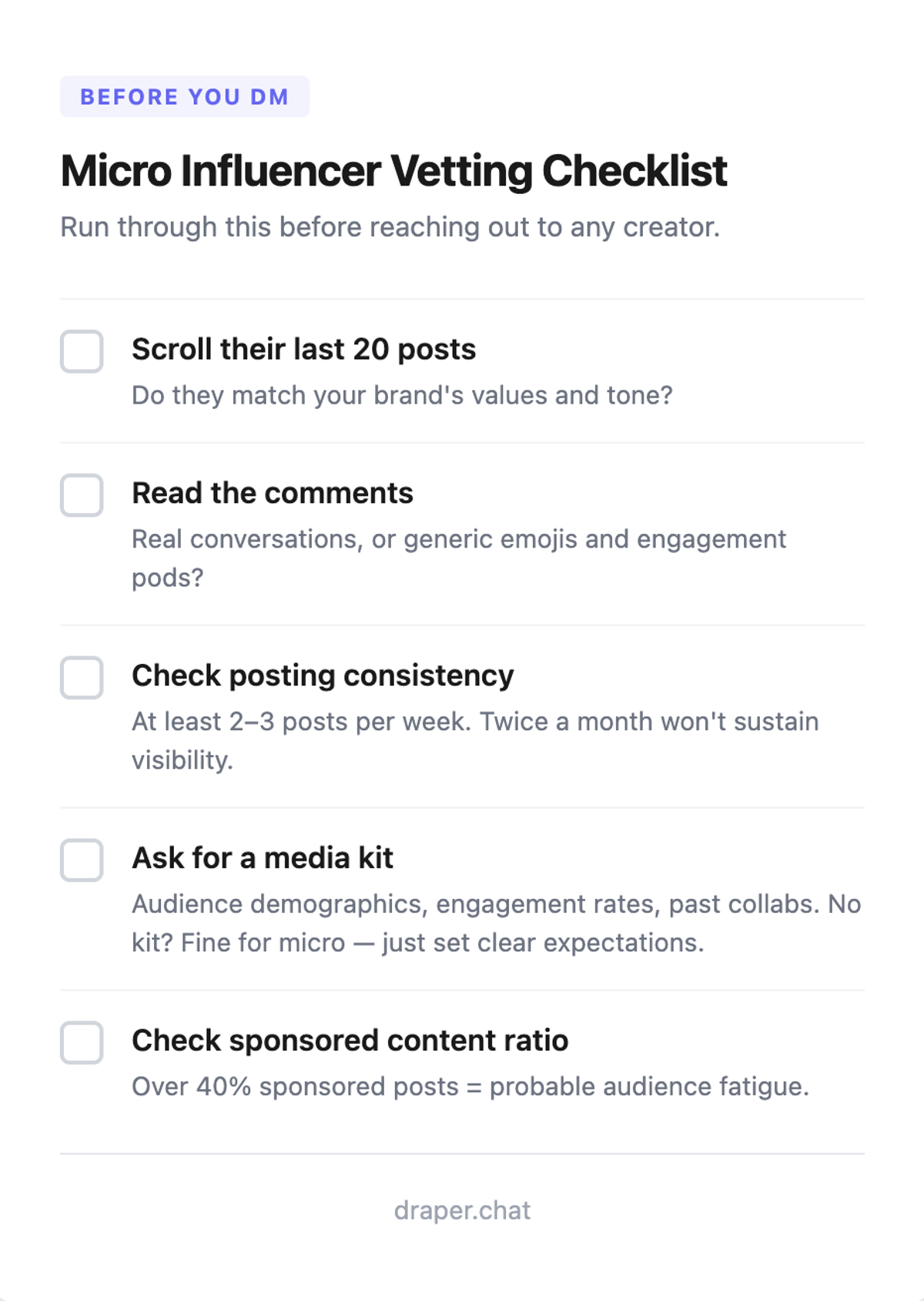
Before you spend time or money, run through this checklist:
Scroll their last 20 posts. Do they match your brand's values and tone? If your brand is minimalist and understated, a creator who posts loud, meme-heavy content probably isn't the right fit, regardless of their follower count.
Read the comments. Are they real conversations? People asking "where did you get this?" or sharing their own experiences is a good sign. Rows of generic emoji comments or one-word replies suggest inflated engagement.
Check posting consistency. If they post twice a month, a partnership won't get you sustained visibility. Look for creators who post at least two to three times per week.
Ask for a media kit or past campaign results. A media kit is a document creators put together showing their audience demographics, engagement rates, and past brand collaborations. If they don't have one, that's fine for nano and micro creators. Just set clear expectations about deliverables and timing upfront.
Look at sponsored content ratio. What percentage of their content is sponsored? If more than about 40% of their posts are paid partnerships, their audience is probably experiencing ad fatigue. The posts that perform best are the ones that feel like genuine recommendations, not the fifth sponsored post this week.
When an AI Tool Is Worth the Investment
Manual discovery works, but it's slow. You might spend five hours finding ten solid candidates. If you're running influencer marketing campaigns regularly or need to find creators in very specific niches, a discovery tool pays for itself in time saved.
Dedicated influencer platforms like Modash (starting at $199/month billed annually) and Heepsy (starting at $49/month) are built for volume. They maintain databases of millions of creators with filters for category, follower count, engagement rate, and location. They're useful when you need to find 20+ creators for a campaign, but the cost is hard to justify for a brand running its first one or two influencer tests.
AI-powered tools like Draper take a different approach. Instead of filtering a static database by category tags, Draper can browse Instagram, TikTok, and X for creators based on content keywords and actual performance data. It assesses likely ROI based on engagement metrics rather than just follower counts. The difference: it finds creators based on what they actually post and how it performs, not just what category they've tagged themselves into.
If you want to skip the five-hour manual search, Draper can surface vetted creators in your niche in minutes. But for your first influencer campaign, the manual methods above work fine. Start there, learn what a good fit looks like, then decide if a tool is worth the investment for scale.
Start With One Creator
Start with one or two creators. Set a budget you can afford to lose, because your first campaign is a learning exercise. Test, measure, and learn what works for your brand and audience.
The best influencer partnerships come from genuine alignment between the creator's audience and your product. No amount of follower count compensates for a bad fit. Find someone whose audience looks like your ideal customer, whose content feels authentic, and whose engagement is real. That's the whole formula.