
What Instagram Reels hooks are working for fashion brands in 2026?

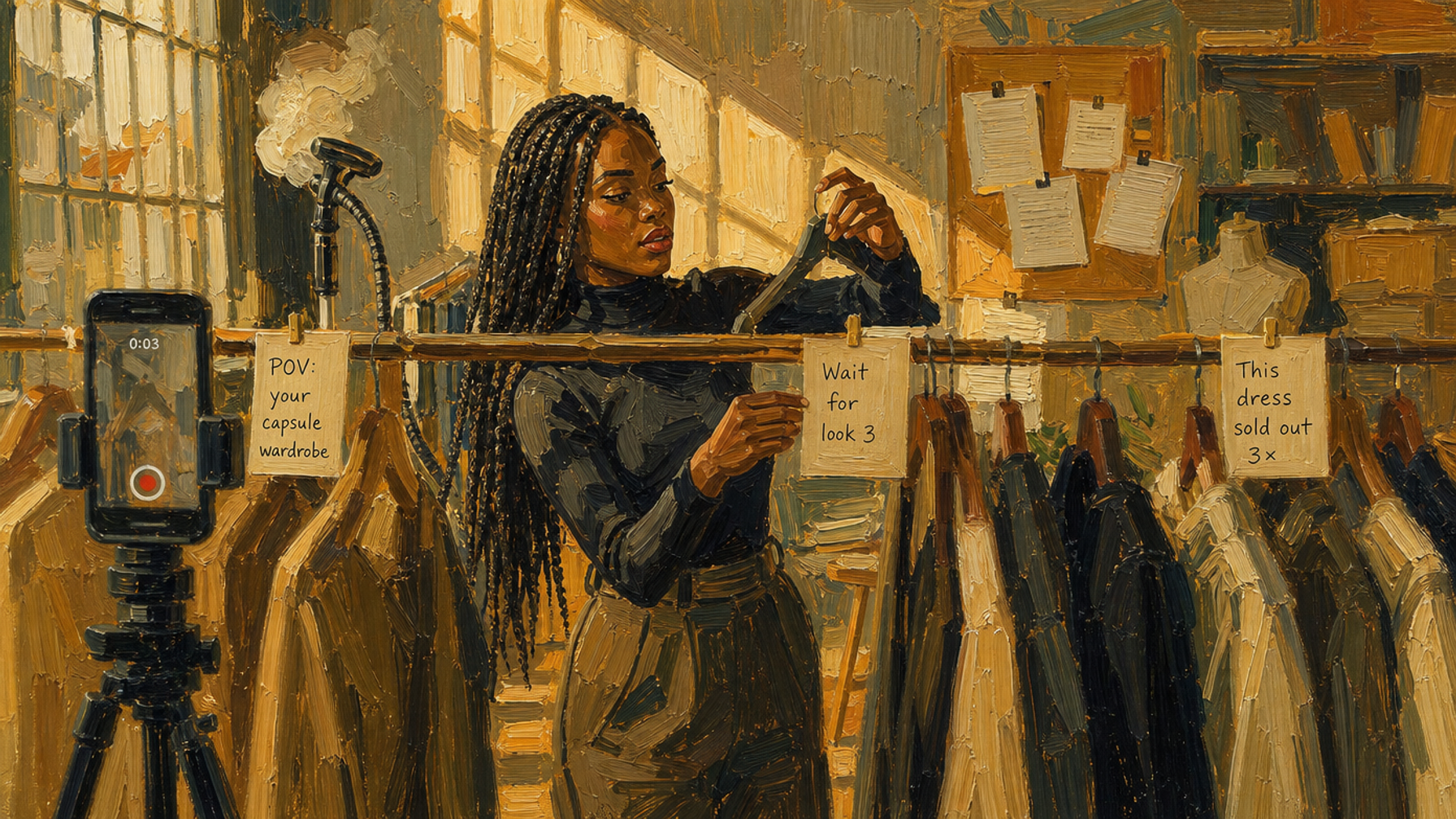
List beats look on fashion Instagram in 2026, on reach. Across the highest-engagement Reels Draper pulled from fashion brand and creator accounts, list and countdown hooks lead the set — @harmin.id's "10 Stunning Styles In One Video" drew 386,800 likes on 14.8M views, the top post in the data by an enormous margin. The number does the work: it promises a fixed set of payoffs and gives the viewer a reason to stay for all of them.
What that post does not do is convert unusually well, and the gap between those two facts is the most useful thing in the dataset.
What does the data show?
Six hook types emerge. Ranked by the share of viewers who liked, rather than by raw counts, the order has almost nothing to do with the order of reach.
- Cultural moment13.6%
@outfrontmediausa — 13,300 likes on 97,600 views. Reportage on another brand's campaign launch rather than a styling Reel, and the audience responds accordingly.
- List / countdown2.6%
@harmin.id — 386,800 likes on 14.8M views. By far the largest reach in the set, on a middling like rate.
- Trend forecast2.4%
@alexxcoll — 23,500 likes on 1.0M views. Caption: "✨ 2026 fashion trends - part 1 ✨".
- POV / scenario2.3%
@sauravnagar_ — 975 likes on 42,100 views. Caption: "Comment Down Your Favourite Day! 🙌".
- Reveal / transformation1.7%
@pariicooper — 330 likes on 19,400 views. Caption: "the details make the look ✨".
- Aspiration0.8%
@lafemmewanderer — 464 likes on 56,900 views. Caption: "Look expensive without spending a fortune 🤎".
Calculated from the like and view counts of the top Reel in each category. Three of these six sit within a third of a percentage point of each other, which is worth remembering before treating any of them as a format effect.
The list hook is a reach instrument. 14.8M views is roughly fifteen times the next-largest post in the set, and that alone justifies briefing it. But its like rate of 2.6% is statistically indistinguishable from the trend-forecast post at 2.35% and the POV post at 2.32% — three formats, three very different audience sizes, and effectively the same conversion. Whatever the number in the caption is doing, it is bringing people in rather than making them care more once they arrive.
Trend forecast scales on a different mechanic. @alexxcoll's "part 1" tag is a series signal that trains the audience to expect more, building a returning-viewer base — and the Reel cleared 1.0M views off it.
The cultural-moment post is the outlier and deserves a caveat rather than a recommendation. @outfrontmediausa's Calvin Klein campaign post converted 13.6% of its audience, five times the list hook — but it is reportage about another brand's launch rather than a styling Reel, posted to an audience that follows campaign news. High conversion on an audience that specifically came for this is not the same finding as high conversion on a cold one.
What Instagram actually says it ranks on
That statement is on the record from Mosseri himself, and it is the reference point for everything below.
What should marketers do with this?
Brief the list hook when the goal is reach. It is the widest-reaching structure in the set by a factor of fifteen, and the construction is replicable: the caption opens number-led ("10 Stunning Styles In One Video"), the number appears large and centred in frame one, and the first look is shown fully styled against a clean background to set the bar. A numbered list is a retention device in the plainest sense — every look the viewer has not seen yet is a reason to stay, and watch time is one of the three signals Instagram has actually named.
Do not expect it to lift conversion. On the evidence here it will not. If the campaign needs people to act rather than to see, the list hook is the wrong instrument and a bigger number in the caption will not fix it.
Put the hook in on-screen text in frame one regardless of format. Plenty of the audience is watching without sound, and a hook that only exists in the audio is a hook that did not happen for them. Force the core premise into the first few seconds and keep anything decorative out of frame one.
Use the embedded comment CTA, but understand what it buys. @sauravnagar_'s "Comment Down Your Favourite Day!" is a good device for finding out which of ten looks people actually wanted, which is genuinely useful when you are deciding what to make next. Instagram ranks very little on comments, so it doesn’t buy you much in distribution.
What's the emerging signal in this data?
Like counts are a misleading read on which hooks are working, and aspiration content is where the gap shows up hardest.
@lafemmewanderer's "Look expensive without spending a fortune" took 464 likes against 56,900 views — a 0.8% like rate, the lowest in the set, on reach that beat four of the other five formats. Nearly sixty thousand people watched a Reel about looking expensive on a budget and almost none of them tapped the heart. That is not a failed Reel. Aspiration content gets screenshotted, saved and sent rather than applauded, because liking it in public is a small admission about your own budget.
The practical version: judge aspiration and trend-forecast work on reach and on sends, not on the like count, and expect the surface metric to look weak on exactly the content that is doing its job. Instagram's own stated signals include sends per reach for a reason — the thing that carries a Reel to people who do not follow you is somebody deciding a specific friend needs to see it. A fashion Reel that gets forwarded with "this is your whole aesthetic" is worth more than one that collects a thousand quiet likes, and only one of those shows up in the number on the screen.
Frequently asked questions
- What Instagram Reels hooks are working for fashion brands in 2026?
- Six hook types recur: list/countdown, aspiration ('look expensive'), reveal/transformation, trend forecast, cultural-moment hijack, and POV/relatable scenario. List/countdown reaches furthest by a wide margin — @harmin.id's '10 Stunning Styles In One Video' took 386,800 likes on 14.8M views, roughly fifteen times the reach of anything else in the set.
- What was the highest-engagement fashion Reel in Draper's analysis?
- @harmin.id's list hook, '10 Stunning Styles In One Video', with 386,800 likes on 14.8M views. Worth separating the two numbers: the reach is exceptional, but 386,800 likes on 14.8M views is a 2.6% like rate, which is unremarkable next to the rest of the sample. The hook is a reach instrument, not a conversion one.
- Do trend-forecast hooks work for fashion Reels?
- Yes. @alexxcoll's '2026 fashion trends - part 1' drew 23,500 likes on 1.0M views. Its 2.35% like rate is effectively level with the far bigger list post, and the 'part 1' tag trains the audience to expect the next one.
- Do comments help a fashion Reel reach more people on Instagram?
- Not directly. In January 2025 Adam Mosseri named Instagram's top three ranking signals as watch time, likes per reach and sends per reach — comments were not among them. An embedded comment CTA is still useful as a read on whether the hook landed, and composing a comment takes time that counts as watch time, but it is not the distribution lever it is often described as.
- Should fashion brands judge Reels on likes?
- Not on likes alone. @lafemmewanderer's 'Look expensive without spending a fortune' collected 464 likes against 56,900 views — a 0.8% like rate on real reach. Aspiration content gets referenced rather than applauded. Judge it on reach and on sends, which is the signal Instagram says carries content to people who do not already follow you.
Related
What TikTok hooks are working for fashion creators in 2026?
Story beats style on fashion TikTok in 2026. Narrative GRWM hooks outperform trend lists and tutorials: the situation is the hook, the outfit comes second.


What Instagram Reels hooks are working for skincare creators in 2026?
Myth-busting hooks reach furthest on skincare Reels in 2026. A different hook wins on comments per view, and Instagram doesn't rank on comments at all.
Are micro-influencers still beating macro-influencers on engagement in 2026?
Micro-influencers still beat macros on average, but tier predicted almost nothing in Draper's data: the best account was a macro. Content-audience fit wins.