According to CB Insights' analysis of startup post-mortems, 42% of startups fail because there's no market need. Not because the product was bad. Not because the team was weak. Because nobody wanted what they built.
The standard advice for avoiding this fate is "talk to customers" and "build an MVP." Both are right, but both are incomplete. Before you talk to anyone, you should know whether people are already talking about the problem you want to solve. If they are, that's demand. If they aren't, that's a signal too.
This guide covers how to find evidence of real demand before you invest serious time or money building something.
What Market Validation Actually Is
Validation isn't proving your idea is good. It's finding evidence that people have the problem you think they have and that they care enough about it to pay for a solution.
There are two layers to this. Problem validation asks: does the problem actually exist, and is it painful enough that people want it fixed? Solution validation asks: is your specific approach the right way to fix it?
Most founders skip problem validation entirely. They have an idea, they assume the problem is real, and they jump straight to building. That's how you end up six months into development with a product nobody asked for. Start by confirming the problem is real. The solution comes after.
Finding Demand Signals Before You Talk to Anyone
This is the step most validation guides skip. Before you set up a single customer interview, the internet can tell you a lot about whether demand exists. People are already describing their frustrations, asking for solutions, and discussing workarounds. You just need to know where to look.
Reddit and Forums
Search for subreddits where your target market gathers. Look for recurring complaints, questions that start with "is there a tool that does X?", and threads where people describe the workarounds they've cobbled together to solve a problem.
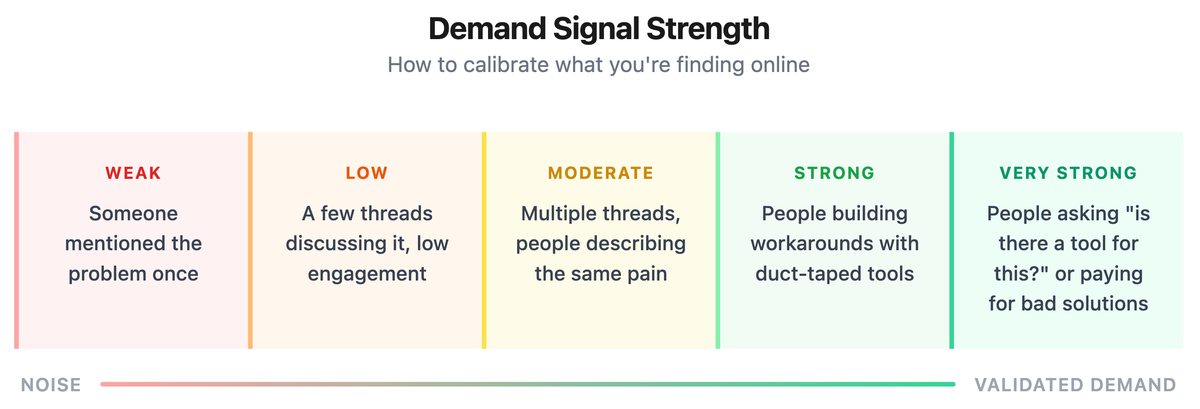
Pay attention to upvotes and comment volume. A post with 3 upvotes is one person's frustration. A post with 300 upvotes and 50 comments describing the same pain is validated demand. Look for the pattern, not the individual data point.
If people are actively building workarounds with spreadsheets, Zapier chains, or duct-taped combinations of existing tools, that's one of the strongest signals you can find. It means the problem is painful enough that people are already investing time to solve it, even badly.
Social Media Conversations
Search for keywords related to the problem on X, TikTok, and Instagram. Look at comment sections on posts from competitors or adjacent brands. What are people asking for that doesn't exist yet? What features do they wish a product had?
On TikTok specifically, check whether people are saving or sharing posts about the problem. A video about a frustration that gets saved 500 times tells you something different than one that just gets likes. Saves indicate intent. People are bookmarking it because they want to come back to it or reference it later.
Google Trends and Search Volume
Is search volume for the problem growing, flat, or declining? Use Google Trends to check the trajectory. A keyword tool like Google's free Keyword Planner can tell you roughly how many people search for terms related to your problem each month.
The distinction that matters: are people searching for solutions (high intent) or just definitions (low intent)? "Best invoicing software for freelancers" is someone actively looking for a product. "What is invoicing" is someone writing a school paper. Volume alone isn't enough. Intent tells you whether that volume represents potential customers.
Putting It Together
You can do all of this manually, or you can use a tool like Draper to scan Reddit, social platforms, and forums for demand signals in your space. The manual approach works. It's just slow. Either way, what you're building is a body of evidence: do people have this problem, how painful is it, and are they actively looking for solutions?
Validating With Real Conversations
Once you've confirmed that the problem seems real, talk to people who have it. The online research tells you what to explore. Conversations tell you whether you're right.
Where to find people: The communities you discovered in the previous step. If you found demand signals in a subreddit, the people posting there are your interview candidates. If you found frustrated comments under a competitor's TikTok, those commenters are your prospects.
What to ask: Focus on their current behavior, not hypotheticals. "How do you handle X today?" is ten times more useful than "Would you use a tool that does Y?" The first question reveals real pain and real workarounds. The second invites people to say yes to be polite, even if they'd never actually pay.
How many conversations you need: Fifteen to twenty gives you pattern recognition. By the tenth conversation, you'll start hearing the same frustrations described the same way. That's when you know you've hit something real. You don't need 100 interviews. You need enough to see the pattern.
Testing Whether People Will Actually Pay
Interest and demand are not the same thing. Likes on a landing page don't mean someone will hand you their credit card. The strongest validation is someone giving you money before the product is finished.
Pre-sales and waitlists with deposits. If people will put down $20 to reserve a spot, that's real. A free waitlist tells you there's interest. A paid waitlist tells you there's demand.
A landing page with a pricing page. You can build this before the product exists. Describe the solution, list the price, and add a signup flow. Track how far people get. If they click "Buy" but there's nothing to buy yet, you've just validated willingness to pay. Dropbox used this exact approach: a demo video and a waitlist signup page took them from 5,000 to 75,000 beta signups overnight, well before the product was ready.
Letters of intent. For B2B products, ask potential customers to sign a non-binding letter saying they'd buy at a given price point if the product existed. It's not a contract, but it's a much stronger signal than "yeah, that sounds cool."
Keep Validating
Validation isn't a checkbox you tick once before building. Markets shift. Customer needs evolve. The founders who stay close to their market, keep scanning for demand signals, and test assumptions before building are the ones who survive the first two years.
Start with the internet. The conversations are already happening. Your job is to find them and listen.