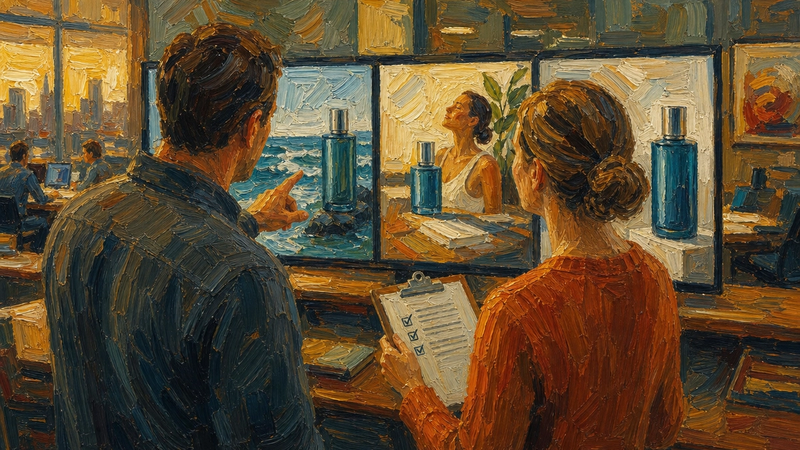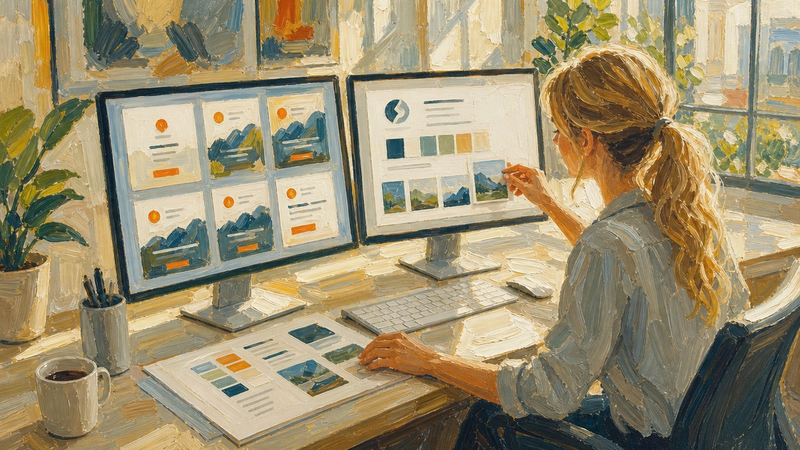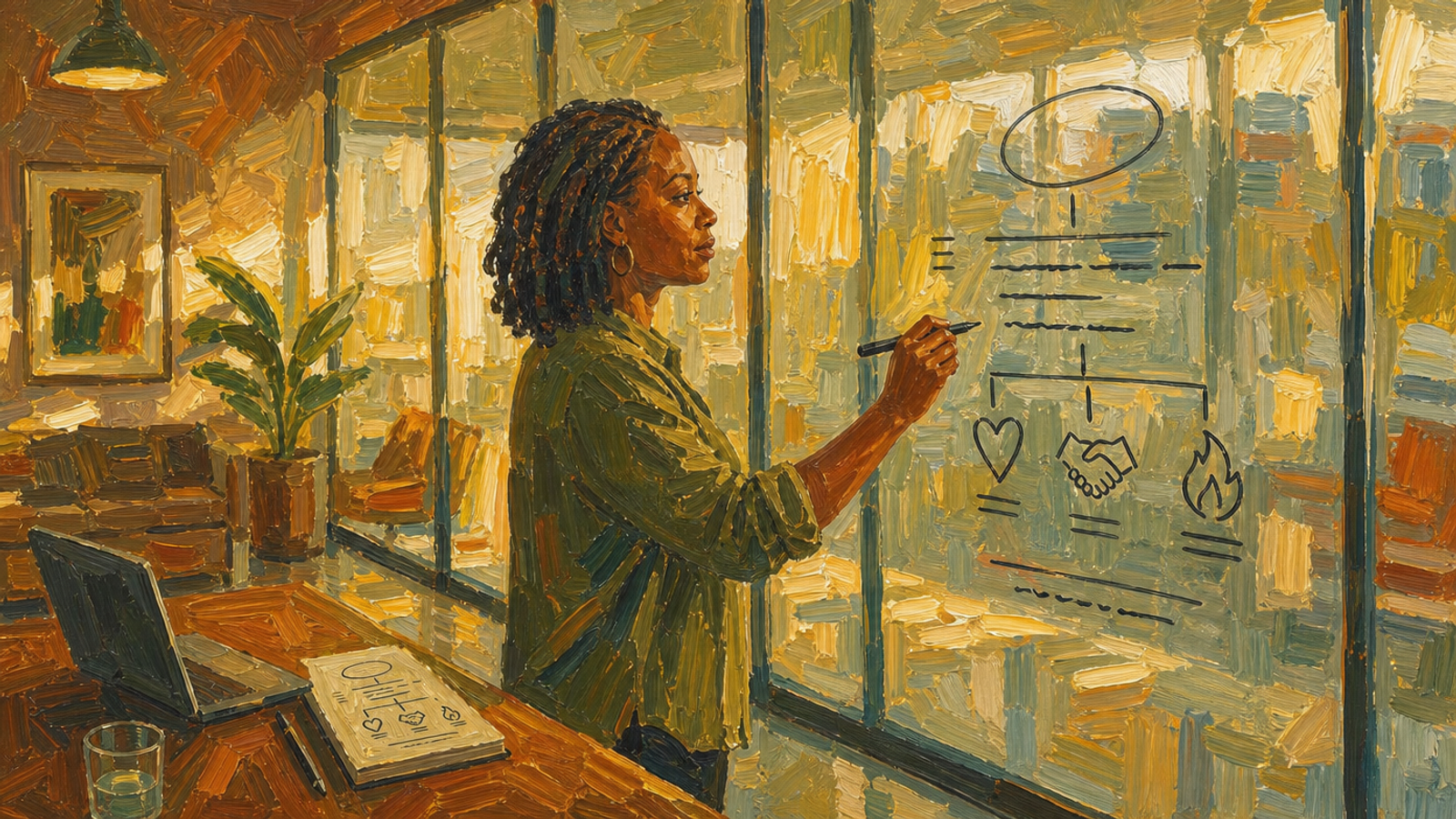
Designing a product with AI starts with the brand, not the product. That order is what a start-a-business app like Draper enforces, because a feature list written before you know the customer produces something competent that nobody in particular wants.
The tools have collapsed in cost. The thinking they run on has not.
- Understand the brand first. Who the customer is, what they respond to, how the brand should sound and feel. Everything downstream is generated against this.
- Write the feature list. Research the customer's pain points online, and use an LLM or a dedicated tool to move faster through the reading.
- Write the look-and-feel list. Colours, materials, texture, art direction — as a list, kept deliberately on brand.
- Set your invariants. The specific targets the product must hit. Size, weight, material, colour.
- Generate the visuals. Product images first, using AI models directed by your brand context.
- Bring it to life. Video and 3D, so the product can be seen from every angle it will be judged from.
- Put it in front of people. A page, a waitlist, and real traffic.
Why does the brand come before the product design?
Because design is what makes the product resonate with the customer, and the evidence for that is unusually strong. McKinsey's 2018 study of design-led companies found the top quartile grew revenue 32 percentage points faster than industry peers over five years, and delivered 56 percentage points higher total returns to shareholders.
That held across all three industries McKinsey examined — medical technology, consumer goods and retail banking — which is what makes it useful. It is not a finding about beautiful objects. It is a finding about companies that design deliberately, in categories as different as banking and medical devices.
The practical version: understand the customer and the brand as you design the features, not after. Our guide on how to design a brand for a new business idea covers how to reach those decisions.
How do you turn a brand into a feature list?
Research the pain point, then write the features that answer it. Read what your customer actually complains about — in their own words, in the places they gather — and turn the recurring complaints into a list of things the product must do. AI shortens the reading, not the judgement.
An LLM will summarise a hundred forum threads in the time it takes to read three, which is a real gain at this stage. Dedicated tools go further by holding your brand and customer in context while they do it, so the summary comes back filtered rather than generic.
What you want at the end is a list you could hand to someone else. Specific enough that a feature is either on it or off it.
How do you decide the look and feel?
Write it as a list: colours, materials, texture, art direction. Keeping it as a list rather than a mood is what makes it usable later, because every one of those lines becomes an instruction you can give a model, a designer or a manufacturer.
Keep it on brand rather than on trend. The look is the part of the product your customer meets first, and it is the part that decides whether they feel it was made for them or for somebody else.
This list and the feature list are the two inputs everything else in this article runs on.
What is a design invariant, and why do experts start there?
A specific, non-negotiable target the product must hit — a size, a weight, a material, a colour. The best product designers set these before they start drawing, because an invariant forces the hard decisions early instead of letting them be traded away one compromise at a time.
Steve Jobs worked this way, and the results are the recognisable ones. The MacBook Air's thickness, the iPhone's screen, the colour of the Apple II — each began as a target that everything else had to bend around.
The iPhone glass is the clearest case. About six months before launch in 2007, Jobs decided the plastic screen would scratch and called Corning's chief executive to demand hardened glass, manufactured at scale, in time. Corning had the material shelved and no production capacity for it, and delivered anyway. The invariant did not move; the supply chain did.
Which AI tools are best for generating product images?
Nano Banana and GPT Image 2 are the strongest models for product images, and both have free usage limits worth using. They are not the best results you can get on their own — a paid harness like Leonardo AI directs them better, and Draper generates from your brand context, which gives the best results.
The pattern repeats across every AI design task. The raw model is capable and undirected; what improves the output is how much of your brand reaches it before it generates anything.
This is also the point where the work stops being free. Professional renders are a real cost, and the product visualisation pricing guide covers what each route charges.
How do you bring the product to life in video and 3D?
Traditionally you pay a designer to build it in CAD software like Fusion 360 or SOLIDWORKS. Blender has come a long way and is free, with good courses behind it. For AI routes, Midjourney creates video and Meshy creates 3D, and Draper keeps the product consistent with your visualisations and brand end to end.
Consistency is the thing to protect here. It is easy to end up with a still, a video and a 3D model that are recognisably three different products, because each was generated separately from a slightly different prompt.
That is the argument for doing this stage in one place rather than three. Our list of the best AI tools to start a business in 2026 covers where each of these sits.
What do you do once the product is designed?
Put it in front of people. Build a page that shows the product and opens a waitlist, then send real traffic to it. A designed product is not a wanted product, and the only thing that settles the difference is strangers who have never heard of you.
This is the step the whole process exists for. Everything before it is preparation — and it is preparation that feels like progress, which is exactly why founders stay in it too long.
Our guide on what to put on a website built to test an idea covers the page, and running ads to test a business idea covers buying the traffic that answers the question.
Related questions
The brand decisions this article assumes are covered in how to design a brand for a new business idea. Once the design exists, how to validate demand before you build is the test it has to survive.