Why we're building Draper
Everyone deserves the chance to create, build and shape their own future. Why Draper exists, what it is setting out to change, and what we want people to build.
 Ben Abbatangelo
Every Draper article on Founders.
Everyone deserves the chance to create, build and shape their own future. Why Draper exists, what it is setting out to change, and what we want people to build.
Ben Abbatangelo
TAM is everyone who could buy, SAM is the slice you can reach, SOM is what you can win this year. Definitions, a worked example, and how to calculate each.
 Tom Hill
Start a business with no money by selling something that costs time, not cash. What to sell first, what the first $100 buys, and what free actually costs.
Tom Hill
Most suppliers on the big sourcing marketplaces are middlemen, not factories, whatever the listing says. Here is how to tell the difference, and why the first quote is never the price.
Tom Hill
Start with the brand, not the product. Set the invariants it must hit, then use AI for the images, video and 3D that make it real enough to test.
 Oliver Bagin
From $0 with Blender to $4,716 a year for SOLIDWORKS Premium, with AI tools between $10 and $120 a month and professional renders at $100 to $300 an image.
Oliver Bagin
Image, video and 3D. Images come first because everything else is built from them, video performs best in ads, and 3D pays off when you need a prototype or a website that holds attention.
Oliver Bagin
AI logo tools split into three kinds, and only two of them actually use AI. Here is what each produces, and the work that is left over after the image appears.
Oliver Bagin
There are seven logo types, but three of them cover most brands. Here is what each one does, and which ones are worth considering in 2026.
Oliver Bagin
Name your business last, not first. Once the customer, the promise and the tone are settled, the name is the easy part — and the easiest to rush.
Tom Hill
Three free tools are live: one for coming up with a business idea, one for sizing your market, and one for working out when your income could cover your bills.
Tom Hill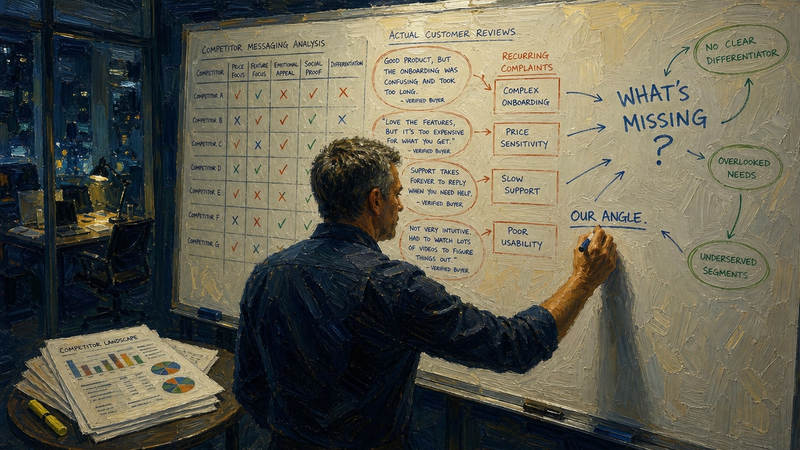
Yes — and you should. Idea theft is rare, being first is not decisive, and secrecy kills more startups than copying ever has.
 Dexter Todd
The case for starting something of your own comes down to ownership. Here is how to test whether it is your move, without betting anything first.
Ben Abbatangelo
Two signs tell you an idea has legs: you can't let it go, and it keeps following you. Live market data tells you the rest.
Ben Abbatangelo
Brand is how a startup earns attention and care. It compounds into funding, feedback and free distribution long before the product is finished.
Dexter Todd
Not everything that feels like validation is validation. What counts, what does not, and how much evidence is enough to start building.
Dexter ToddWith no budget, validate the idea first, then write by hand to the people already posting about the problem. Free acquisition costs time, not cash.
Dexter Todd
The 12 validation questions to ask customers, with examples of what a good answer sounds like — and the one question that ruins an interview.
Ben Abbatangelo
Validating a business idea costs between nothing and about $500 in 2026. Here is what each budget buys, and the order to spend it in.
Dexter Todd
Seven methods that cost nothing but time, ranked by the strength of the evidence each one produces. Asking friends is on the list, at the bottom, and it is not validation.
Tom HillRanked on coverage: how much of the path from idea to first paying customer each tool handles on its own, and where the narrow ones still beat the broad ones.
Tom HillA good coach with real domain experience beats software. The problem is cost and variance — you pay for months before you can tell which coach you hired.
Ben AbbatangeloShopify gives you the storefront. Draper works out what to sell, to whom and at what price — then keeps the sequence going after launch.
Ben Abbatangelo
Lovable builds the site. Draper works out whether the idea behind the site is worth building — and what the site should therefore say.
Ben AbbatangeloNothing else on this list is a start-a-business app. Each alternative wins on one slice of starting a business — here is which slice, and when it beats Draper.
Ben Abbatangelo
ChatGPT and Claude are generalist models that answer what you ask. Draper is a start-a-business app that holds the path and pushes the next right step.
Ben Abbatangelo
A start-a-business app takes one person from an idea to a running business, doing the work of product, marketing, legal and finance rather than advising on it.
Ben AbbatangeloTest the idea on real customers while your salary still covers the rent. Hybrid founders who go full-time later fail less often than founders who quit first.
Ben Abbatangelo
Draper is a start-a-business app: one AI mentor coordinating product, marketing, legal and finance departments that unlock in stages as your business moves.
Ben AbbatangeloYou don't invent a brand, you assemble one from references — and the useful ones come from what your customer already loves elsewhere.
Tom Hill
No. A trademark covers a name or a logo, not the idea. Validate the idea first, then protect the name once it is worth something.
Dexter Todd
Most idea validators are a chatbot with a scoring screen. Here is what each kind actually does, what none of them can know, and when a verdict is worth anything.
Dexter Todd
Finding competitors is the good result — it proves people pay for this. What you need is an angle, and it lives in the gap between what everyone competes on and what customers complain about.
Dexter Todd
You want to start a business but have no ideas yet. You need three constraints and an evening — here is how to get to four candidates you can test.
Dexter ToddAn ad test asks three questions in a row: can you reach your market, do they respond to your description, and will they give you an email. It answers no far better than yes.
Tom Hill
One page, one promise, a price and an email field. Build it in a day — the longer you spend on the page, the less able you are to hear the answer it gives you.
Dexter Todd
A seven-step process: list the rooms your customers already gather in, rate your standing in each, and work through them in that order — then buy traffic to go faster once you know what to say.
Dexter Todd
A market is real when the people in it already gather somewhere, describe the problem unprompted, and share words for it. Here is how to check, in an afternoon, for nothing.
Dexter Todd
Most ideas fail on a promise nobody wants, not on the product. This is the cheapest way to find that out before you build — and what one week of evidence can and cannot tell you.
Tom Hill