
What is an RFQ? How to request and compare factory quotes

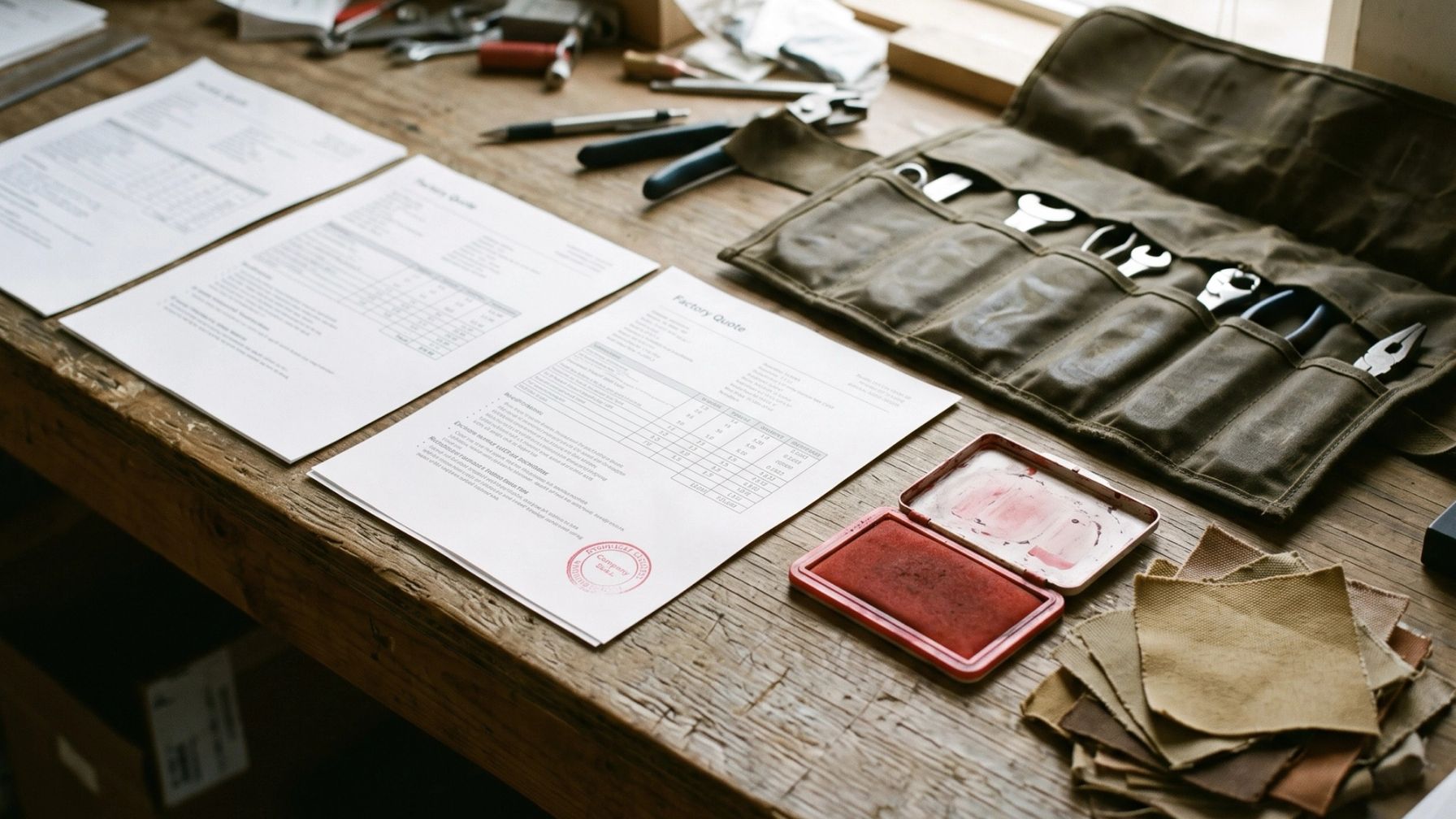
An RFQ (request for quotation) is a document a buyer sends to several suppliers, asking each one to price the same product at the same quantities and on the same terms. Because every supplier answers the same questions, the quotes can be compared line by line.
This guide is for a founder making a physical product, sold online with pre-orders, who has a few factories to write to and is about to ask for prices. If you haven't found any yet, start with where to find a manufacturer.
What is an RFQ?
RFQ stands for request for quotation, also called a request for quote. You send one when you already know what you want made and need prices. A request for proposal (RFP) asks suppliers how they would solve a problem, and a request for information (RFI) collects background on suppliers before anyone is asked for a price.
Neither the RFQ nor the quote that comes back commits you to buy. You commit when you sign the purchase contract, usually after you have approved a sample.
A worked example: a waxed canvas tool roll
The numbers below are invented and round. A founder is launching a waxed canvas tool roll for gardeners in one color, olive, with a leather patch carrying the logo and a printed card sleeve as retail packaging. They expect a first order of about 300 units if the pre-orders go well, and hope to sell around 1,500 a year once the product is established. They have three factories to write to: A, B and C.
1. Write the spec before you contact anyone
Put these in writing, so every factory prices the same product:
- what the product is and what it must do, with dimensions;
- the requirements you won't change, which for the tool roll are 16 oz waxed cotton canvas, a real leather patch and brass rivets;
- what the factory may choose, such as the thread;
- the logo: its position, size and method (here, embossed on the patch);
- the packaging, and how many units go in a carton.
Marking what is open lets a factory suggest a cheaper option where you don't mind one. If you're unsure how custom the product needs to be, see white label vs private label.
2. Make first contact, then protect the design
Your first email to a factory is a short hello, without drawings. Say who you are and describe the product in a line ("a waxed canvas tool roll, made to our design"). Give honest volumes, clearly marked as estimates: how many you expect to order first and how many a year after that. A factory that quotes for a bigger order than you will place may lose interest or raise its price later. Ask whether it makes this kind of product, and who should receive your request.
If the design is your own, ask the factories that reply to sign an NNN agreement (non-use, non-disclosure, non-circumvention), and send the full RFQ only to those that sign. For a first product, three factories give you enough to compare.
3. Set the quantities and terms
Ask for prices at the quantities that matter to you: the first order you will actually place, and a couple of larger ones you might reach on reorder. The tool roll founder chose 300, 600 and 1,500. Your pre-orders will pay for the first; the other two show what reorders will cost.
Then fix the terms, so every quote comes back on the same basis:
- Currency: US dollars, so you compare the quotes without converting any of them.
- Shipping term: FOB (free on board), at a named port near the factory. Under the ICC's Incoterms rules, the factory clears the goods for export and loads them on board the ship you nominate, and the risk passes to you once they are on board. Freight, insurance and duty come after that, in the landed cost.
- A reply date, a couple of weeks out. Factories shut for Chinese New Year (6 February 2027) and slow down over Golden Week (early October), so give them more time if your request lands close to either.
- No target price. A number in the request anchors every quote to it, so keep the price you hope for to yourself.
4. List every item you want priced
Ask every factory for the same items, in the same order, so the answers sit side by side. This RFQ template is written as an email, so you can paste it into each thread and attach the spec:
RFQ email template
Send the same email and attachments to each factory, and keep a copy of what each one received. Draper's sourcing workshops write this request in English and Chinese, and the Draper team introduces founders to three manufacturers to send it to.
5. Line the quotes up
Quotes rarely come back exactly as asked, so read each one in full before you set them side by side. Here are the three for the tool roll:
| Factory A | Factory B | Factory C | |
|---|---|---|---|
| Shipping term | FOB Ningbo | EXW | FOB Shenzhen |
| Unit price at 300 / 600 / 1,500 | $9.80 / $8.90 / $7.60 | Not quoted / $8.20 at 500 / $7.10 | $10.40 / $9.50 / $8.30 |
| MOQ | 300 | 500 | 200 |
| One-off costs | $120 patch die | None listed | None |
| First order at the factory | $3,060 for 300 | $4,100 for 500 | $3,120 for 300 |
| Changes from the spec | None | 10 oz canvas, synthetic patch, no sleeve | None |
| Samples | 2 for $90, 10 days | 1 for $50, 7 days | 2 for $120, credited to the order, 14 days |
| Production lead time | 35 days | 30 days | 40 days |
| Payment | 30% deposit, 70% before shipping | 100% upfront | 30% deposit, 70% before shipping |
Factory B looks cheapest, and it shows most of what to watch for. Its $8.20 is 16% below Factory A's $9.80, yet its MOQ of 500 makes its first order $1,040 bigger than A's, because a factory's minimum becomes your first order. Its price is EXW (ex works), which stops at the factory with the goods not loaded and not cleared for export, so loading, export clearance and the trip to the port would be yours to pay. And its remarks swap in thinner canvas, a synthetic patch and no sleeve. Changes like these are where cheap quotes usually come from, so ask B for an FOB price on the spec as written before you compare it with anything. Ask every factory to show tooling, dies and set-up as separate lines, and to confirm in writing that you own any tooling you pay for.
A and C are $60 apart on the first order, close enough for the samples to decide.
How many units to order is the next decision, covered in what is MOQ. What each quote costs once freight and duty are added is in landed cost and break-even.
6. Check the company before any money moves
Do these checks before you pay even a sample fee. For the order itself, the usual arrangement is a 30% deposit when you order and the other 70% before shipment, which Harris Sliwoski's China law blog calls the norm in Chinese manufacturing. On Factory A's first order, that is $918 up front and $2,142 before the goods ship. Factory B wants the whole amount up front, which is worth questioning.
In business email compromise, someone gets into or imitates a supplier's email and uses it to send new bank details. The FBI's 2024 public service announcement counts $55.5 billion in exposed losses from these scams between October 2013 and December 2023.
Before you pay a factory
7. Sample, then choose
Pay for samples from the factories still in the running, which in the example are A and C. A sample is only useful if it is made the way the order will be, with the same materials on the same line. Ask for photos before it ships, and get it in writing whether the fee comes off the first order.
Then weigh the quote and the sample alongside your experience of each factory so far, since you'll work with the one you pick on every order. A factory that flagged its own changes and answered your questions promptly is easier to work with than one that left you to find surprises in the remarks.
Place the order itself once pre-orders cover it, as part of testing demand before you build.
Company seals (chops) on Chinese quotes and contracts
Chinese companies stamp formal documents with a company seal (公章), usually called a chop. It is round and red, carries the company's full registered Chinese name, and is made and filed through the Public Security Bureau, as China Justice Observer explains. A contract seal (合同专用章) bearing the company's name is also valid on contracts.
Under Article 490 of China's Civil Code, a written contract is formed when the parties sign it, stamp it or put their fingerprints on it. A seal shows that the company named on it agreed to the document. It doesn't show that the company makes your product, and seals are sometimes forged, so check the name on it against the business license and the bank account you pay.
On the purchase contract, ask for the company seal and the signature of the legal representative named on the business license. Harris Sliwoski warns that some Chinese companies try to get out of contracts by claiming the person who signed had no authority. Query a finance or invoice seal on a contract, since companies use those with banks and tax offices. A quote doesn't need a seal.
You don't need a seal of your own. Under the same article, your signature is enough.
When you don't need a full RFQ
- For a white-label product from a catalog, the prices are published. Confirm the shipping term, the MOQ and what the price includes in writing.
- With a local workshop, there's no shipping term or seal. Still send each maker the same spec and quantities.
- If a sourcing agent sends the requests for you, find out the name of the factory that will actually make the product, and have that factory sign the NNN as well as the agent.
Related questions
If you are still choosing who to write to, where to find a manufacturer covers telling a factory from a middleman. Once a factory is chosen, what is MOQ settles the order size.
Frequently asked questions
- What is the difference between an RFQ, an RFP and an RFI?
- An RFQ asks suppliers to price something you have already specified. An RFP, or request for proposal, asks them to suggest how they would solve a problem, so the answers differ in more than price. An RFI, or request for information, collects background on suppliers before you ask anyone for prices. A founder buying a product from a factory usually needs an RFQ.
- Is an RFQ legally binding?
- No. An RFQ asks for prices, and the quote that comes back is the supplier's price for the terms you asked about. Neither commits you to buy. What binds both sides is the purchase contract or order you sign later, usually after you have approved a sample.
- How many suppliers should I send an RFQ to?
- Three is a common choice for a first product. A single quote leaves you nothing to measure it against, and every extra factory adds another round of samples and questions to manage. If only one factory replies, ask for more introductions before you choose.
- What should an RFQ include?
- A specification with drawings, the quantities you want priced, the currency, the shipping term such as FOB, and a reply date. Then a list of what each supplier should quote: unit prices, the MOQ, one-off costs such as tooling, sample cost and timing, production lead time, payment terms, how long the quote is valid and what the price includes. Leave out your target price, so it doesn't anchor the quotes.
- What is a company chop in China?
- It is a company's official seal: a red, round stamp bearing its full registered Chinese name. Chinese law treats a seal, a signature or a fingerprint as the way a written contract is formed, so the seal shows the company agreed to the document. It doesn't prove the company makes your product, and seals can be forged, so check the name on it against the business license and the bank account you pay.
Related

Where to find a manufacturer for a physical product
Most suppliers on the big sourcing sites are middlemen, not factories, whatever the listing says. How to tell them apart, and why the first quote isn't final.


What is MOQ? Minimum order quantity for your first order
MOQ (minimum order quantity) is the smallest order a supplier will accept. What it means, why it exists, and how to size and negotiate your first order.
