
Golden sample: what to check before mass production

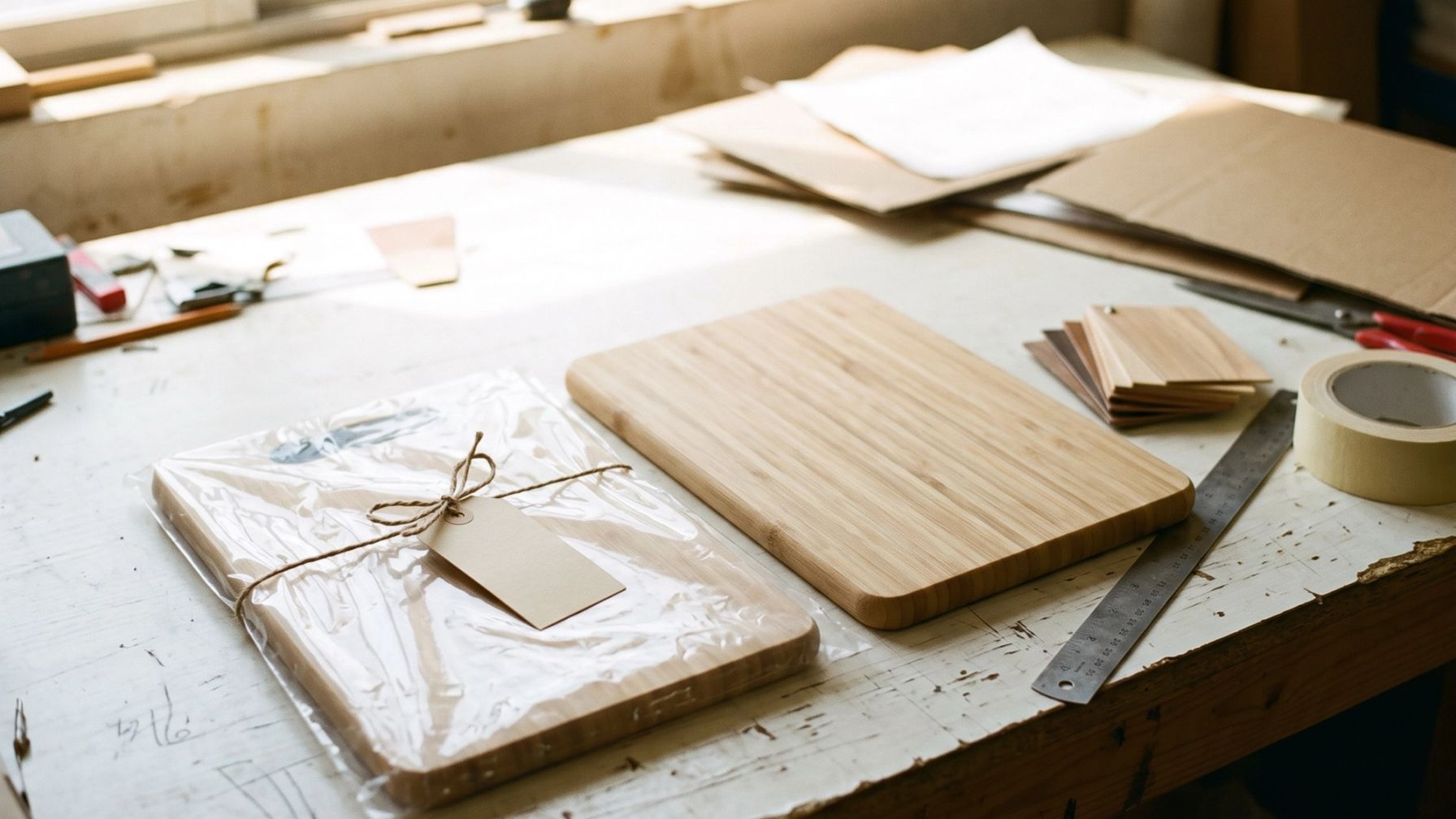
A golden sample is the pre-production sample you approve before mass production starts. You and the factory each keep an identical copy, signed and sealed, and the factory's finished order is checked against it before you pay the balance.
This guide is for a founder having a physical product made to sell online with pre-orders, who has chosen a factory and is waiting for samples. While samples are still going back and forth, a change costs a courier fee and a few weeks. Once you have signed one, the factory can fairly say that anything matching it is what you ordered.
The sample stages from prototype to pre-shipment inspection
Quality consultant Renaud Anjoran counts any sample made before mass production as a pre-production sample, and the golden sample as the final one, which production should copy. HKTDC also calls it an approval sample. The stages in order:
| Stage | Who makes or checks it | What it tells you |
|---|---|---|
| Prototype | You, a designer or a local maker, often with 3D-printed or hand-made parts | Whether the design works |
| Pre-production sample | The factory, before mass production; ask for the order's materials and process | Whether this factory can make it to your spec |
| Golden sample | The factory; it is the pre-production sample you approve | What every unit in the order must look like and do |
| Production | The factory, sometimes with an inspector checking the first units | Whether the line matches the golden sample |
| Pre-shipment inspection | An inspector, on random units from the finished order | Whether the order matches your spec and the golden sample |
A worked example: a bamboo cutting board
The details and dates below are invented and round. A founder is launching a bamboo cutting board with a juice groove, and plans a first order of 500 boards. Her product specification sheet says:
- Size 400 × 280 × 20 mm, with a tolerance of ± 2 mm on length and width and ± 1 mm on thickness.
- Carbonized bamboo, food-safe mineral oil finish, logo laser-engraved in one corner.
- Color matched to a physical stained bamboo chip that she and the factory both hold.
- Rocks no more than 1 mm on a flat table, and the groove holds 60 ml without spilling.
- Survives 30 rounds of hand washing and drying with no cracks or open glue lines.
- Kraft sleeve with a barcode and "Made in China", 10 boards to a shipping carton.
1. Ask for a sample made the way the order will be made
Many factories make samples in a separate sample room, away from the production line. Ask for yours to come off the line, from the same batch of material the order will use, and with the logo engraved, printed or stamped exactly as on the order. In the example, that means laser engraving. Ask for photos and measurements before it ships, so an obvious problem costs you no courier fee.
Order two units if the fee allows: one to test until it breaks, one to measure and keep.
2. Check every line of the spec against the sample
Write a result next to each line of your spec. Where the sample misses, write the change as a number, such as "length 397 mm, must be 398 to 402 mm."
In the example, the first sample came back 397 mm long, a little darker than the chip, and with one glue line opened 3 mm after the wash test. The groove, the flatness and the packaging passed. She has no way to test the finish for food contact herself, so she asked the factory to send its lab report with the next round.
What to check on each sample
Draper's Review Partners workshop helps you choose between factories on their quotes and samples, with the checks for each sample taken from your spec.
3. Send the changes in writing, all at once
Put every change in one numbered message with photos and measurements, since each separate request can cost a separate round. Ask the factory to confirm each change and say when the next sample will be ready.
If the same line fails twice, ask the factory what stops it from hitting the number. When the line can be read two ways, rewrite it with a number and the test that checks it. When the cause is the material or the machine, decide whether you can accept a looser tolerance, and put that in writing, or move to the next factory on your shortlist.
4. Plan the number of sample rounds and their dates
How many rounds you need depends on how much the factory changes for you. A stock product with only your logo and packaging may need nothing more than the final set. A product the factory adapts often takes two or three rounds before it.
In the example, each round takes four weeks: two for the factory to make the sample, one for the courier and one for her to run the wash test and reply.
| Stage (invented times) | Weeks | 2027 dates |
|---|---|---|
| Round 1: make, courier, test | 4 | May 10 to June 7 |
| Round 2: make the changes, courier, test | 4 | June 7 to July 5 |
| Final set: make three identical boards, courier hers, approve | 3 | July 5 to July 26 |
| Golden sample approved | 11 in total | July 26 |
Round 2 fixed the length and the glue, and the color matched the chip. Had it missed again, a third round would have moved approval to August 23, and every date after it four weeks later. That includes the ship date you give customers. The pre-orders guide counts the ship date from the day pre-orders close, which assumes the sample is already approved, so if it isn't, add the rounds still to come. If a round runs into Chinese New Year (February 6 in 2027), ask the factory for its closure dates and add them.
If a quote counts its production lead time from the deposit, production still waits for your approval. Approve the golden sample before you pay the deposit on your first order.
5. Approve the golden sample and record it
Ask the factory to make the final sample as a set of identical units: one is sent to you, one stays with the factory and one waits there for the inspector. HKTDC's guide says the final samples should be signed, dated and sealed. In practice that means:
- Tie a tag to each unit with the date and a sample number, signed by the factory before anything ships. Sign and date your own copy's tag when you approve it.
- Put each unit in a bag, seal it, and sign across the tape so any opening shows.
- Ask the factory to stamp its company seal on the tags and the tape. The RFQ guide explains what a Chinese company seal means and how to check one.
- Photograph each copy from every side with a ruler in shot, and write down its measurements. For the two at the factory, ask for these photos before they are sealed.
- Send an approval email that lists the sample number, the photos and any difference from the spec you have accepted. Name the sample number in your purchase contract.
The factory's copies stay sealed until the inspector opens one. Keep yours out of the sun, since finishes and colors fade.
6. Use the golden sample at the pre-shipment inspection
A pre-shipment inspection happens at the factory before you pay the balance. HKTDC puts it at the point where the order is fully produced and 80% packed. The inspector checks a random sample of units against your spec and the golden sample, and passes or fails the order using an acceptance quality limit (AQL, also written acceptable quality level).
AQL sampling comes from the standards ISO 2859-1 and ANSI/ASQ Z1.4. The order size and an inspection level give the number of units to check, and the AQL you choose sets how many defects that sample may contain before the order fails. You set a separate limit for each class of defect.
In the example, the 500 boards fall in the 281 to 500 lot-size row. With single sampling, normal inspection and general inspection level II, which V-Trust calls the most commonly used level, that row gives code letter H and a sample of 50 boards (Cosmo Sourcing reproduces the tables). She uses V-Trust's default limits of 0 for critical, 2.5 for major and 4.0 for minor defects. At code H, the order passes with no critical defects, up to 3 major (4 fails it) and up to 5 minor (6 fails it) among the 50.
She defines each class from the spec and the golden sample before the inspector arrives:
- Critical: a crack, a splinter, mold, or anything that makes the board unsafe.
- Major: a size outside the tolerance, a color that doesn't match the golden sample, a groove that spills, a barcode that won't scan.
- Minor: a small finish mark a customer might notice but that doesn't affect use.
V-Trust charges $268 a person-day in China's main manufacturing regions, travel included, and the example budgets one day. That is $0.54 a board on 500 boards, and the landed cost guide shows where it sits among the other costs. Pay the balance only once the report comes back as a pass. If it fails, the factory reworks the faulty units and the order is inspected again, so agree in the purchase contract who pays for the second visit.
When you need less than a full golden sample process
- A white-label product the supplier already makes needs one sample of the product with your logo and packaging, signed and kept the same way.
- With print-on-demand, order one unit of each design to your own address and check it there.
- A small batch from a local maker can be checked in person against the first finished units.
- On a reorder, reuse the golden sample. Make a new one when you change anything in the spec, or when the old one has worn or faded.
Related questions
A golden sample is checked against your spec, so write the product specification sheet first. Before paying for samples at all, a priced page with a small ad budget can test demand before you build.
Frequently asked questions
- What is a golden sample in manufacturing?
- It is the pre-production sample a buyer approves before mass production starts. The buyer and the factory each keep an identical copy, signed, dated and sealed, and the finished order is inspected against it. It is also called an approval sample or approved sample.
- What is the difference between a pre-production sample and a golden sample?
- A pre-production sample is any sample the factory makes before mass production starts, ideally with the materials and process the order will use. You may go through two or three of them while you ask for changes. The golden sample is the one you finally approve, and it becomes the reference for production.
- How many golden samples should you keep?
- At least two identical units: one with you and one at the factory. Many buyers ask for a third for the inspection company. Each copy should be signed, dated and sealed so nobody can swap it, and photographed with its measurements written down.
- What happens if production doesn't match the golden sample?
- If the pre-shipment inspection finds more defects than your agreed limit, the order fails. You hold the balance payment, the factory reworks or remakes the faulty units, and the goods are inspected again before they ship. Agree in the purchase contract who pays for the second inspection.
- What is AQL in a pre-shipment inspection?
- AQL stands for acceptance quality limit. It comes from the sampling standards ISO 2859-1 and ANSI/ASQ Z1.4, which set how many units an inspector checks for a given order size and how many defects that sample may contain before the order fails. You choose a limit for each class of defect, such as critical, major and minor.
Related
How to write a product specification sheet for a factory
A product specification sheet tells a factory what to make and how it will be checked. What to put in one, with a worked example and a note on tech packs.

What is an RFQ? How to request and compare factory quotes
An RFQ (request for quotation) asks suppliers to price the same product on the same terms. What to send a factory, an email template, and how to compare quotes.

How to do pre-orders before you manufacture a product
How to do pre-orders for a product you haven't made: set a ship date you can meet, choose when to charge, follow the FTC rule and test demand first.
