Why do startups need a strong brand?


Startups need a strong brand because attention and care are the scarcest inputs in a new market, and brand is the most reliable way to earn both. Draper is a start-a-business app that builds the brand alongside the idea, for exactly this reason.
The usual objection is that brand is what you do once the product works. That order is backwards, and the cost of getting it backwards is invisible — you never see the six months of compounding you skipped.
What does a strong brand actually do for a startup?
Companies that get people to care about them and pay attention outperform companies that do not. Brand is the most reliable way to earn both. It converts into funding, feedback, forgiveness for unfinished features, and distribution that a finished product alone cannot buy.
Brand is not the logo. The logo is one artefact of it. Brand is the set of reasons a stranger would choose to pay attention to you before they have any evidence that they should — the name, the visual language, the point of view, and the consistency with which all three show up.
That matters most at the beginning, when you have no track record to trade on. A startup's early asset base is almost entirely attention and goodwill. Brand is the machinery that produces both, and it starts producing before the product ships.
Two startups, six months: which one is in a better position?
Take two hypothetical startups founded on the same day. One launches first — an Instagram page, a waitlist, an engaged audience — and builds the product second. The other spends the same six months heads-down building. At the six-month mark, the marketing-led company has more options.
At a glance: the same six months, spent two ways
| At the six-month mark | Startup that built an audience first | Startup that built the product first |
|---|---|---|
| Has a product | No, or an early version | Yes |
| Can raise from investors | Yes, on evidence of demand | Harder, with no demand signal |
| Can generate capital now | Yes, via paid waitlist, pre-sales or the audience itself | Only by selling to strangers from a standing start |
| Can attract an audience next | Already has one | Cannot easily convert a finished product into attention |
| Knows what to build | Yes, from an audience already talking | Only from assumption |
The asymmetry is the point. The audience-first company can still build the product, funded and directed by the audience it has. The product-first company cannot parlay a finished product into an audience with anything like the same ease.
Why does an audience convert into more options than a finished product does?
An audience is optionality. It can be shown to external investors as evidence of demand, monetised directly, or converted into capital through a paid waitlist or a crowdfunding campaign. Each of those gives the founder a way to fund the build. A finished product with no audience gives them one option: go and find customers.
This is where founders misjudge the trade. Building the product feels like the productive choice because the output is visible at the end of each week. Cultivating an audience produces nothing you can demo for the first few months, then produces several routes at once.
The audience also tells you what to build. A company with people already paying attention starts development with a queue of real requests. The other one starts with a guess, and finds out whether the guess was right after it has spent the six months.
What does brand do for a startup after launch?
Strong brand loyalty buys tolerance. A startup people are rooting for is allowed unfinished features, rough edges and slow fixes. It also gets more feedback and more engagement on what it ships, so it learns faster than a competitor with the same product and no loyalty.
Speed of learning is the compounding variable in early-stage companies. Two startups can ship identical version ones. The one whose users care enough to complain in detail gets a better version two, sooner.
That tolerance is finite, and it is worth being precise about what it is not. Loyalty buys time on a bug; it does not survive a product that never gets better. What it does is widen the window in which you are allowed to be imperfect — and for a startup, that window is often the whole difference between iterating and dying.
Why is brand self-reinforcing in a way product features are not?
People broadcast their association with brands they think are cool, so brand carries a viral factor by default. Product virality exists too, but it has to be engineered deliberately. Brand-driven sharing happens because someone wants to be seen choosing you.
Merchandise is the clearest evidence of the effect. Companies from Anduril to PostHog sell merch that people actively want to wear — and every item worn in public is marketing the company did not have to buy. Nobody wears a t-shirt for a feature.
That is the loop: brand earns attention, attention earns advocates, advocates broadcast the brand, and the broadcast earns more attention at no marginal cost. A product loop can be built to do something similar, but it has to be designed, instrumented and maintained. The brand loop is a by-product of being worth associating with.
Isn't building brand before product just marketing something that doesn't exist?
Yes, partly, and that is a real risk rather than a rhetorical one. An audience built on a promise decays if the promise is never delivered, and a strong brand attached to a weak product accelerates the discovery that the product is weak. Brand-first is not a substitute for building.
The honest framing is sequencing, not replacement. Brand-first means the audience exists by the time the product is ready, not that the product never arrives. The failure mode is treating the waitlist as the finish line.
The second real limit: brand compounds slowly. Six months of consistent presence produces something; three weeks produces nothing, and founders who test it for three weeks conclude it does not work. If you are not prepared to be consistent for months, the honest choice is to build.
How do you build a strong brand before you have a product?
Start with the decisions that do not depend on the product being finished: who it is for, what point of view it carries, what it is called, and what it looks like. Those are answerable on day one, and they are what an audience actually attaches to.
This is why Draper helps its users build a strong brand rather than treating branding as a later stage. The research that establishes who the customer is produces the raw material for the brand at the same time — the language, the positioning, the reason someone would care.
For the practical version of that work, see our guide on designing a brand for a business idea. For what the start-a-business app does across the whole path from idea to launch, see what Draper actually does.
Frequently asked questions
- Why do startups need a strong brand?
- Companies that get people to care about them and pay attention outperform companies that do not. Brand is the most reliable way to earn both. It converts into funding, feedback, forgiveness for unfinished features, and distribution that a finished product alone cannot buy.
- Why does an audience convert into more options than a finished product does?
- An audience is optionality. It can be shown to external investors as evidence of demand, monetised directly, or converted into capital through a paid waitlist or a crowdfunding campaign. Each of those gives the founder a way to fund the build. A finished product with no audience gives them one option: go and find customers.
- Why is brand self-reinforcing?
- People broadcast their association with brands they think are cool, so brand carries a viral factor by default. Product virality exists too, but it has to be engineered deliberately. Brand-driven sharing happens because someone wants to be seen choosing you.
Related

How do I design a brand for a new business idea?
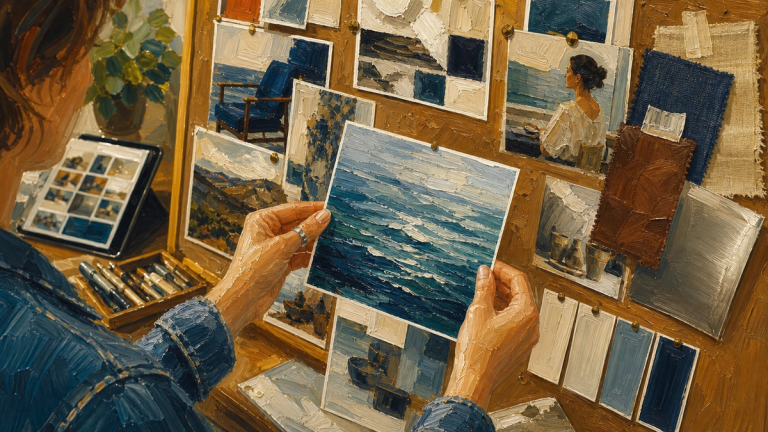
You don't invent a brand, you assemble one from references — and the useful ones come from what your customer already loves elsewhere.

How do I name my business?
Name your business last, not first. Once the customer, the promise and the tone are settled, the name is the easy part — and the easiest to rush.

Types of logos and when to use each
There are seven logo types, but three of them cover most brands. Here is what each one does, and which ones are worth considering in 2026.
