
What is a feasibility study? How to check a product idea

A feasibility study is a check, done before you commit money, of whether a plan can work in practice. For one physical product it asks four things: can someone make it, does each sale leave money, can you reach buyers without spending all of it, and can you legally sell it?
Most guides describe a long formal report for a building or IT project. A single product idea needs about a week of desk research, and it ends in a decision to go ahead, change the idea or stop. Below is that version, with one feasibility study example carried through every step. It assumes you will sell a physical product online and take pre-orders before you order stock.
What a feasibility study covers
Project-management guides usually split feasibility into five areas: technical, economic, legal, operational and scheduling. For a small product business, three of them do most of the work:
- Technical: who can make this product, at what quantity and price?
- Economic: does each sale leave money once the product and delivery are paid for, and is there still some left after paying to win the customer? This half is what people mean by a financial feasibility study.
- Legal: does the product need testing, a certificate or a registration before it can go on sale?
Operations and scheduling matter less at this size. You run the operation yourself, and the factory's lead time sets the schedule.
Run the check once you have some sign that people want the product. If you haven't got that yet, start with how to test demand before you build.
Feasibility study example: a toddler climbing triangle
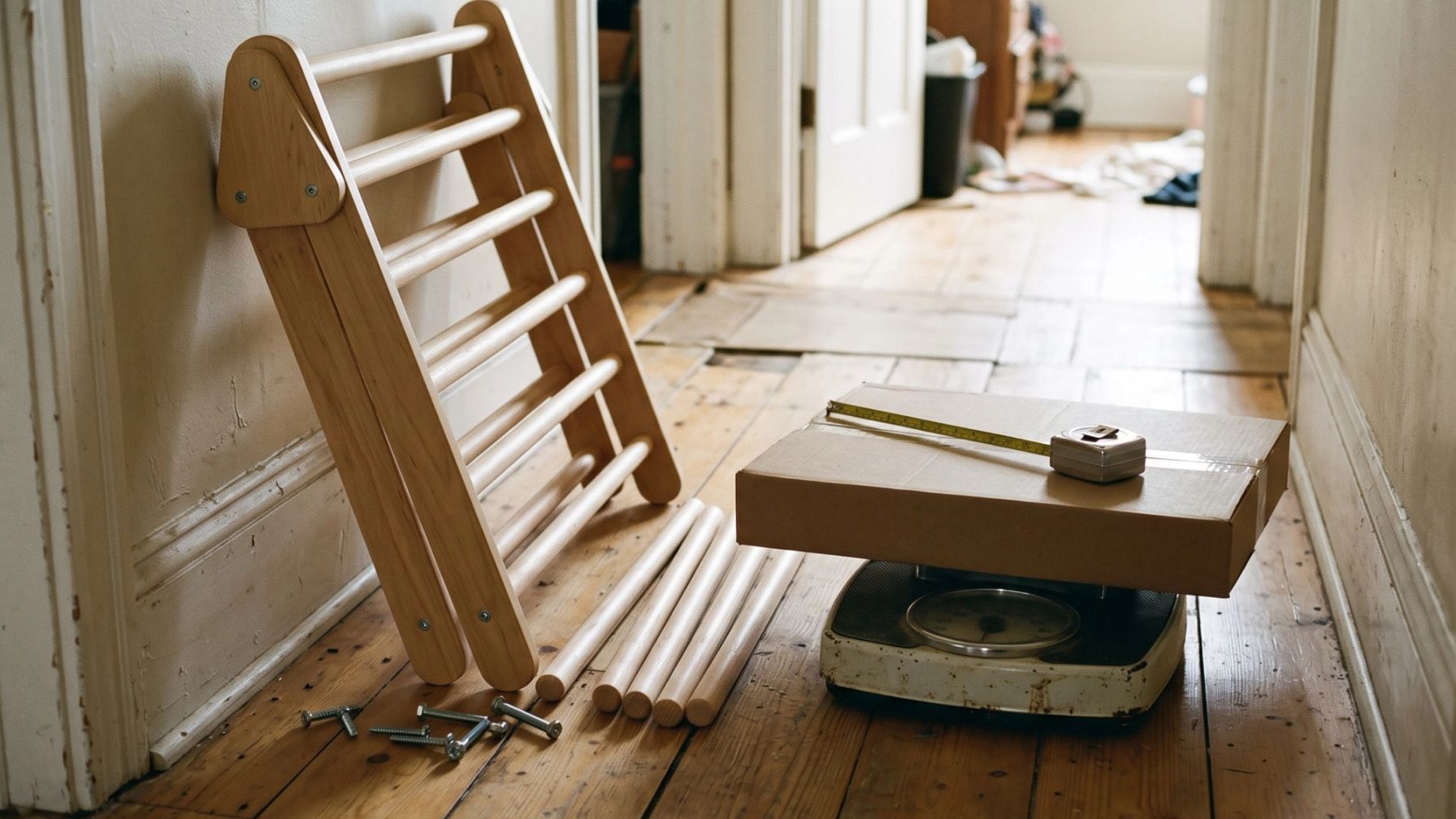
The numbers in this example are invented and round. A founder wants to sell a wooden climbing triangle for toddlers from her own US website. Three similar triangles sell for $109, $139 and $179, so she starts at $129.
Her version has a birch frame and five rungs, folds for storage, and is for ages 1 to 3. She will say it is for climbing play and nothing more. Pin your own version down the same way first, since a different material or a bigger promise changes the costs and sometimes the rules.
A one-week feasibility check
1. Find out who could make it
Find two or three ways to get a first batch made, and note the unit price and minimum order for each. A small maker will often do 20 units at a high price. A factory charges far less per unit but wants a few hundred, and that minimum sets how much cash the first batch needs (what MOQ means). If a supplier already sells something close to your idea, putting your brand on their product is often the cheapest start (white label vs private label).
Supplier listings are enough for now; ask for formal quotes once the idea passes. For where to look, see where to find a manufacturer.
A local cabinet maker charges $95 a triangle for 20, which loses money at $129 before any ads. Factory listings for similar frames show a minimum order of 200 at about $34 a unit, so the founder tests the factory route.
2. Work out the landed cost of one unit
Add freight, duty and tariffs, inspection and the other charges between the factory and your door to get the landed cost (how to work out landed cost). Freight is priced by size as well as weight, so a bulky product can cost nearly as much to ship as to make. Then spread one-off costs, such as lab testing, over the first batch.
Here, $34 at the factory plus $24 to reach her door gives a landed cost of $58. Testing for the batch costs $1,400, or $7 a unit across 200, so each triangle costs her $65.
3. Set a price and work out what each sale leaves
Start from what buyers pay for the products yours will sit next to. Your cost plus a markup can land well above or below that, and buyers only see the comparison. If your price is higher than theirs, your product page has to show what the extra money buys.
Then take away everything each order costs: the unit, the card fee, delivery, packaging and a returns allowance. What is left is the contribution margin. Advertising comes out of it, so step 4 compares it with what a customer costs to win.
Stripe charges 2.9% plus 30 cents for a payment with a US card, $4.04 on a $129 order. The triangle ships in a large, heavy box, so delivery costs $30. Packaging is $3 and the returns allowance $6. Each sale leaves $20.96.
4. Work out what each customer costs to win
Divide what an ad test spent by the orders it brought in. Without a test, mark any figure you use as a guess.
If a customer costs more than a sale leaves, each one you pay to win loses you money. Families buy one climbing triangle per child, so the first order has to cover that cost. A product that runs out, such as coffee or candles, can earn it back over later orders, as long as you have evidence that people reorder.
The founder's demand test spent $600 on ads for 16 pre-orders: $37.50 a customer. Each sale leaves $20.96, so every customer won through ads costs her $16.54. Her friends and local parent groups cost less to reach, but they don't hold 200 buyers.
5. Check the product rules where you will sell
Find out what the law requires before the product can go on sale in your country. Who the product is for changes the answer, and so does what you say it does: the FDA's page Is it a cosmetic, a drug, or both? explains how a claim can turn a cosmetic into a drug. Have a specialist confirm what applies before launch.
The triangle is a children's product: the US Consumer Product Safety Commission (CPSC) defines that as a product designed or intended primarily for children 12 or younger. It has to be tested by a third-party, CPSC-accepted lab against the children's product safety rules that apply to it. The importer, here the founder, must then issue a Children's Product Certificate based on those test results. Since July 8, 2026, importers of most regulated consumer products must also file their certificates electronically with US Customs and Border Protection.
The triangle and its box also need a tracking label: permanent marks giving the importer's or private labeler's name, where and when it was made, and the batch or run number. None of this blocks the product. It costs the $1,400 counted in step 2 and adds time, so ask the lab which rules it will test against and how long that takes.
How claims change which rules apply
6. Decide whether to go ahead, change it or stop
Put the four answers side by side and make one call:
- Go ahead if someone can make it, each sale leaves money after paying for the customer, and the rules are known and affordable. Next come samples, formal quotes and pre-orders.
- Change the idea if one check fails and a specific change fixes it. Work out the new numbers on paper first, and make sure the change keeps the feature your pre-order buyers asked about.
- Stop if a check fails and no change you would accept fixes it, or the rules put the product out of reach.
In the example, step 4 fails because of the box. The founder tries a version whose rungs slide out, so it packs into a box about half the size. The factory charges $2 more for the hardware, but freight and import costs fall from $24 to $16 a unit, so the landed cost is $52, and delivery drops to $15.
| Per sale | As tested | Smaller box | Smaller box at $139 |
|---|---|---|---|
| Price | $129 | $129 | $139 |
| Unit with testing | $65 | $59 | $59 |
| Card fee | $4.04 | $4.04 | $4.33 |
| Delivery | $30 | $15 | $15 |
| Packaging and returns | $9 | $9 | $9 |
| Left per sale | $20.96 | $41.96 | $51.67 |
| After $37.50 customer cost | -$16.54 | $4.46 | $14.17 |
At $129, the smaller box leaves $4.46 per customer won through ads, too little to absorb a weak week of ads. Parents in her demand test asked about storage, which supports $139 for the flat-packing version, level with the middle competitor. That leaves $14.17 per customer.
She goes ahead with the changed version. The cash needed before the first sale is 200 units at $52, $1,400 of testing and $300 of samples: $12,100. Next come samples of the slide-out version and formal factory quotes. She will measure the cost of a customer again while pre-orders run, since it is the number most likely to move.
Draper's Check Feasibility workshop does this research with you for your own product, including the regulations where you plan to sell.
When you need more than a one-week check
- If the product needs a regulator's approval before it can be sold, that approval decides feasibility. Many medical devices need FDA clearance or approval first, so talk to a regulatory specialist before anything else.
- If you are borrowing money, a bank or investor may ask for a full written study or business plan, and the numbers above are a start on it.
- If you sell software, a service or digital downloads, the questions are the same, but the numbers become the cost to serve a user or the hours in a delivery.
- If you make the product by hand, add your time per unit to the materials. The number you can finish in a week also limits how many orders you can take.
Related questions
Once the check says go, a pre-mortem looks for what could still sink the business. To get a real cost per customer, see how to run ads to test an idea.
Frequently asked questions
- What are the five types of feasibility study?
- Technical, economic, legal, operational and scheduling. Technical asks whether it can be built, economic whether it pays, legal whether it is allowed, operational whether the people and processes can run it, and scheduling whether it can be done in time. For one physical product, the first three carry most of the weight.
- What is a financial feasibility study?
- It is the money part of a feasibility study: whether the project earns back what it costs. For a product business, that means the landed cost of a unit, what each sale leaves after card fees, delivery and returns, what a new customer costs to find, and the cash needed before the first sale.
- What is the difference between a feasibility study and a business plan?
- A feasibility study asks whether the idea can work at all and ends in a decision to go ahead, change it or stop. A business plan assumes you are going ahead and sets out how. Do the feasibility check first, so you don't plan a business that can't make money.
- How long does a feasibility study take?
- A formal study for a building or IT project is a long report, often written by consultants. A check on a single physical product takes about a week of desk research, using supplier listings, published fees, a small ad test and the regulator's own guidance. Samples and formal quotes come afterward, if the answer is to go ahead.
- Do I need a consultant for a feasibility study?
- Not for one product. Consultants earn their fee on large projects, bank loans and heavily regulated products. For a small product business you can answer the main questions yourself. If your product falls under specific safety or health rules, pay a specialist to confirm them before you launch.
Related

Is my idea worth building? How to test demand
Most ideas fail on a promise nobody wants, not on the product. The cheapest way to find out before you build, and what a week of evidence can and can't show.


What is MOQ? Minimum order quantity for your first order
MOQ (minimum order quantity) is the smallest order a supplier will accept. What it means, why it exists, and how to size and negotiate your first order.
