NNN agreement: protect your design from a Chinese factory

An NNN agreement is a contract in which a manufacturer promises not to share your product information (non-disclosure), not to use it except to make your order (non-use), and not to go around you to your customers or suppliers (non-circumvention).
This guide is for a founder about to have a physical product made in China, usually to sell online. It is general information, not legal advice.
What is an NNN agreement?
NNN stands for non-disclosure, non-use and non-circumvention:
- Non-disclosure: the factory doesn't pass on your drawings, specification, formula or logo.
- Non-use: it doesn't use them for itself or anyone else, for example by making your design and selling it under another name.
- Non-circumvention: it doesn't use what it learned through you to sell directly to your customers or cut you out of your supply chain.
A standard NDA covers only the first. Harris Sliwoski, a law firm that writes these for clients making goods in China, says most Western NDAs ban disclosure but "say nothing about competitive use or circumvention". A factory that copies your design has no reason to disclose it. It makes and sells the product, which only the non-use clause forbids.
Why a US-style NDA does little in China
A typical US NDA is in English only, governed by a US state's law, with disputes heard in a US court and the factory named by the English trade name on its website. If the factory breaks it, you sue in the US, win, and then need a Chinese court to recognize that judgment before you can reach the factory's money. Harris Sliwoski's 2026 guide on enforcing US judgments says Chinese courts now do this case by case, but it is "still not easy or inexpensive", and the firm's own China contracts "virtually never" send disputes to a US court when the Chinese party's assets are in China.
The same firm calls naming a Chinese company only by its English trade name "virtually meaningless in China". A Chinese court needs the registered Chinese legal name and address.
A worked example: an oak tablet stand
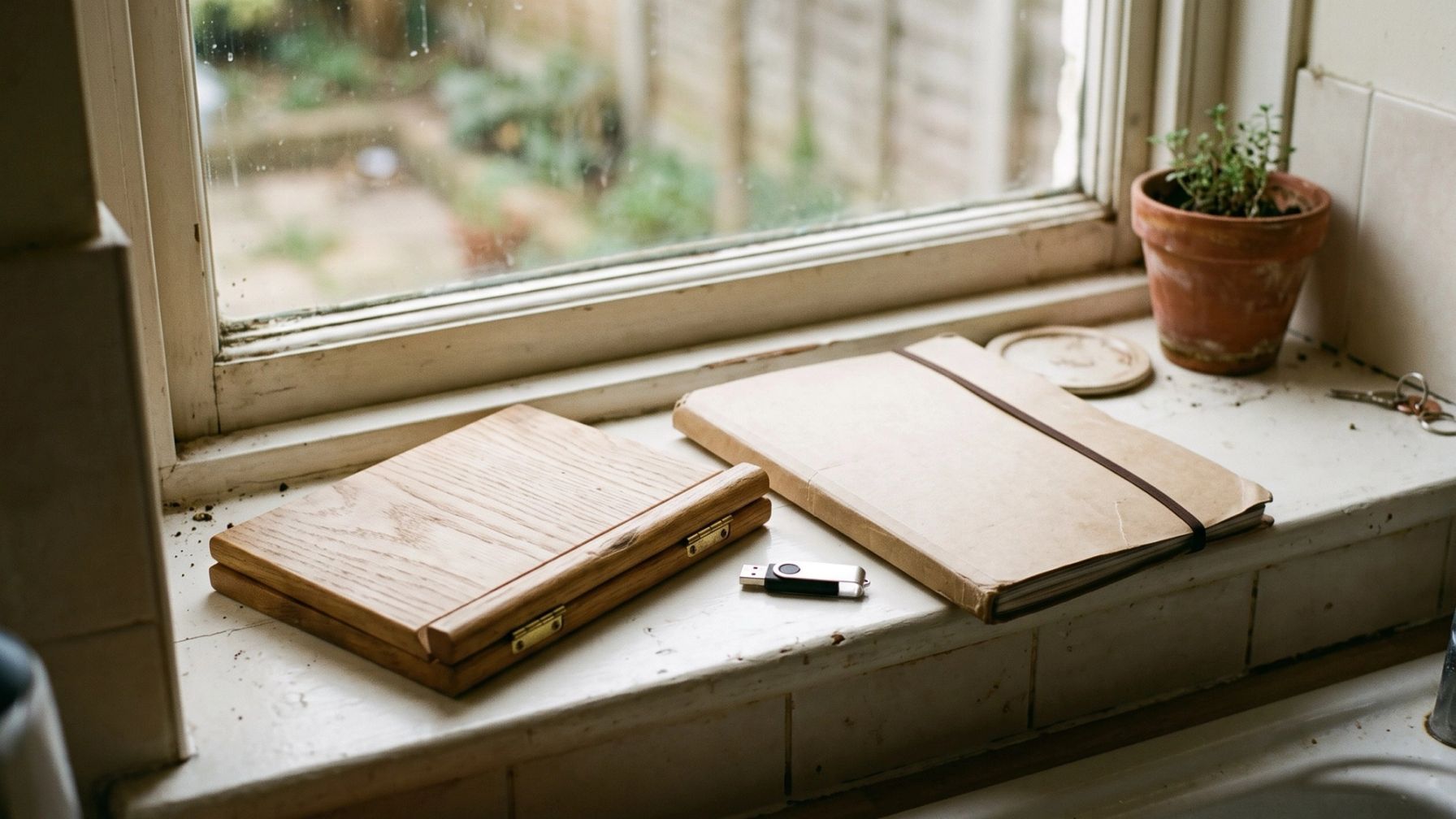
The numbers are invented and round. Maya has designed a folding oak stand that holds a tablet on a kitchen counter, with a brass hinge she worked out herself. She will sell it for $60 and plans a first order of 400 with about 2,000 a year if it sells (both estimates). The hinge and the brand are what she wants to protect.
1. Check the factory before you send anything
Maya finds five candidates on a sourcing marketplace. Before she tells any of them about her product, she asks each for a copy of its business license and checks that it makes wooden household goods itself. One turns out to be a trading company that won't say which factory would make the stand, so she drops it. An agreement signed by a middleman puts no duty on the factory it hires, and the guide to finding a manufacturer shows how to tell the two apart.
The license also gives her what the agreement needs: each company's registered Chinese name and address.
2. Send a short first email without drawings
Her first email to the four that are left says who she is and that she wants a folding wooden tablet stand made to her own design. It gives her first order and yearly volume, marked as estimates, and asks whether they make this kind of product. Nothing in it would let a factory make or brand the stand. Harris Sliwoski's advice is to get the NNN signed before you disclose anything important.
Send the NNN with that email or as soon as a factory replies. Draper's Reach Out to Manufacturers workshop writes the first email, a bilingual NNN and the RFQ as one set. Here is what goes out at each stage:
| Stage | Maya sends | Still private |
|---|---|---|
| First email | Who she is, what the product is, estimated volumes | Anything visual, the hinge design, her price |
| Factory replies | The NNN to sign | Same as above |
| Signed NNN checked | Full spec and drawings, with her [request for quotation](/blog/what-is-an-rfq) | Her target price |
| Factory chosen | A manufacturing contract | Nothing |
3. Write the NNN for a Chinese court
Harris Sliwoski's NNN guide points to these features in an agreement a Chinese court will enforce against a factory:
- A Chinese version that controls. If English controls, a Chinese court works from a translation.
- Chinese law, and a Chinese court with jurisdiction over the factory and its assets.
- The factory's registered Chinese name and address, matching its business license.
- The company's official seal, and a signature from someone with authority to sign.
- A damages figure agreed in advance. China's Civil Code, Article 585, lets parties agree a sum payable for a breach, and lets a court or arbitration body reduce it, if a party asks, when it is "excessively higher than the loss caused". Harris Sliwoski warns that an astronomical figure can weaken the clause. A fixed sum means you can claim it without first proving what the breach cost you.
Maya's NNN sets damages at a fixed RMB 500,000 per breach, the same figure the workshop puts in its NNN. She doesn't have to work out a number of her own.
4. Check the signed copy before the drawings go out
Three factories sign and return the NNN. The fourth sends it back with only a salesperson's signature, and when Maya asks for the company seal, stops replying. She doesn't send it her spec.
Before you send drawings to a factory
The RFQ guide's section on company seals explains each kind of seal and how to spot a wrong or forged one.
5. Send the full spec only to factories that signed
Maya then sends her product specification sheet, drawings and logo to the three factories that signed. Keep every signed NNN, including those from factories you don't choose. They already hold your drawings, and the firm's NNN guide points out that a rejected factory's NNN may be your only protection against it long after production starts somewhere else.
6. Register your trademark in China
An NNN does nothing at China's trademark office. China is a first-to-file country, so the first person to apply for a mark there usually gets it, whoever used it first. A 2026 Harris Sliwoski article on squatters notes that some are current or former manufacturers with access to the brand, and that a squatter can ask Chinese customs to detain goods carrying the mark, including your own exports.
File the trademark in China before the logo goes to a factory
If you live outside China and file with CNIPA directly, CNIPA's rules for foreign applicants say you must use a Chinese trademark agency. A revised Trademark Law in force from 1 January 2027 adds fines of up to 100,000 yuan for some bad-faith filings, and Harris Sliwoski's guide, updated since it passed, still says to register early.
This blog's trademark article says to wait until a name has real customers before registering it. China is the exception: the first filer usually wins there, and a factory is about to hold your logo.
7. Put tooling and ownership in the manufacturing contract
Once Maya picks a factory and approves a sample, she signs a manufacturing contract. Harris Sliwoski notes an NNN doesn't settle who owns the molds or tooling, or who owns new technology the factory develops. Maya's hinge needs a custom die, so the contract states that she owns it once paid for and that it can't be used for anyone else.
What an NNN doesn't cover
- Your product's look and mechanism once it is on sale. A competitor who buys one and copies it never signed anything. A design patent or patent registered for China covers that.
- Companies that didn't sign: a subcontractor, a sister company or the factory behind a trading company. Ask for the company that actually receives your files to sign.
- A guarantee. It gives you a contract a Chinese court can enforce and a damages figure to claim, and you still have to sue to collect.
- An NNN also can't show when the design was yours. If a factory later claims it already made something like your product, dated records of your own work help: sketches, emails, the files you sent and the date each factory signed. If you worked the design through in Draper, our team can issue a certified transcript of those conversations, showing what you said and on which day.
If your design is worth patenting, file the patent application before you contact any factory.
Related questions
Most ideas are safe to talk about, as is it safe to share my startup idea explains. A production design needs protecting once you have tested demand and are about to send a factory your files.
Frequently asked questions
- What does NNN stand for?
- Non-disclosure, non-use and non-circumvention. The factory agrees not to pass your information on, not to use it for anything except making your order, and not to go around you to deal directly with your customers or suppliers.
- What is the difference between an NDA and an NNN agreement?
- An NDA usually forbids only disclosure. An NNN also forbids the factory from using your design for itself and from cutting you out of your own supply chain. With a Chinese manufacturer, the bigger risk is the factory making and selling your product itself, which a disclosure-only NDA does little to stop.
- Is an NNN agreement enforceable in China?
- It can be, if it is written for a Chinese court. That means a Chinese version that controls, Chinese law, a Chinese court that can reach the factory, the factory's registered Chinese name, its company seal, and an agreed damages figure. An English NDA under US law would need a US judgment and then a separate case to have it recognized in China, which is neither easy nor cheap.
- Should an NNN agreement be in Chinese or English?
- Both, with the Chinese version stated as the one that controls. A Chinese court works in Chinese, so if the English controls, the court works from a translation. Keep the English alongside so you know what you signed.
- Does an NNN agreement protect my trademark in China?
- No. China registers trademarks on a first-to-file basis, and an NNN does nothing at the trademark office. If your brand name or logo will go to a Chinese factory, file the trademark in China in your own name as well.
- Can I prove I had the design before a factory saw it?
- Keep dated records: your sketches, your emails, the files you sent and the date each factory signed its NNN. If you developed the design in Draper, our team can issue a certified transcript of those conversations, showing what you said and on which day.
Related
What is an RFQ? How to request and compare factory quotes
An RFQ (request for quotation) asks suppliers to price the same product on the same terms. What to send a factory, an email template, and how to compare quotes.

How to write a product specification sheet for a factory
A product specification sheet tells a factory what to make and how it will be checked. What to put in one, with a worked example and a note on tech packs.
Where to find a manufacturer for a physical product
Most suppliers on the big sourcing sites are middlemen, not factories, whatever the listing says. How to tell them apart, and why the first quote isn't final.
